 GAOERJI STEEL


Search
Heavy Structural Steel Fabrication: Design Standards
Heavy structural steel fabrication standards dictate the precise material selection, welding procedures, and dimensional tolerances required for massive load-bearing frameworks. Adhering to baseline codes like AISC 360-22 or EN 1090 guarantees basic structural integrity. Standard codes fail to address the complex thermal distortion inherent in welding massive jumbo sections. Theoretical design standards lose their value the moment a 100mm flange plate warps during shop assembly due to improper heat input. Here is exactly how top-tier structural engineers bridge the gap between theoretical building codes and the brutal physical realities of the fabrication shop floor.
The S.A.F.E. Compliance Pyramid for Heavy Steel Structure Fabrication
Structural failures rarely stem from mathematical errors in static load calculations; they originate from a disconnect between design models and fabrication constraints. The S.A.F.E. Compliance Pyramid provides engineers with a sequential framework to evaluate heavy steel structure fabrication feasibility before cutting the first steel plate.
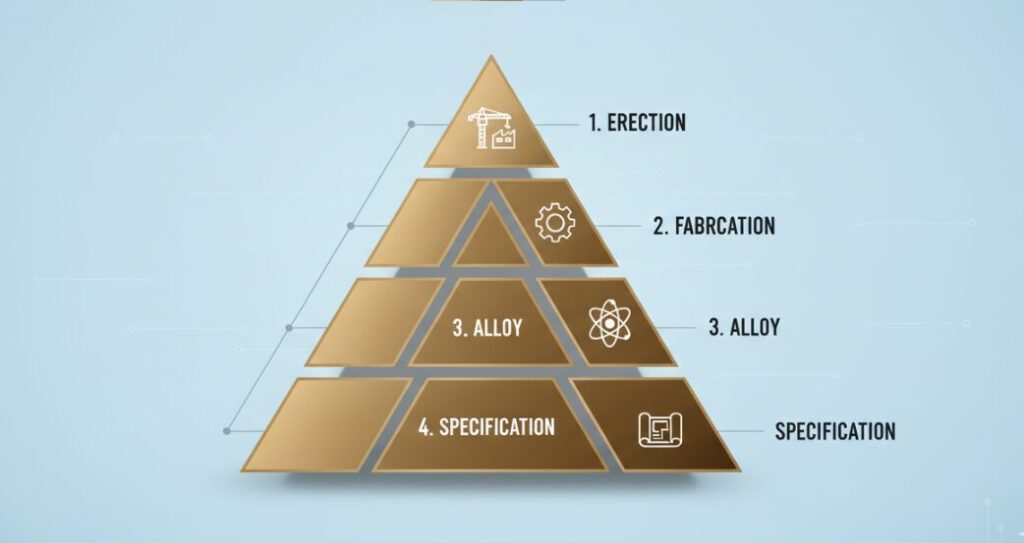
Specification Alignment
Design specifications must explicitly address the joint details specific to heavy structural steel fabrication. Relying on default pre-qualified weld joints often leads to massive rework. AWS D1.1 outlines strict limitations for highly restrained joints in thick materials. Engineers must manually specify preheat and interpass temperatures in the construction documents to prevent hydrogen-induced cracking, rather than leaving these parameters solely to the fabricator’s discretion.
Alloy Selection and Thermal Dynamics
Thick structural steel plates behave differently under thermal stress than standard commercial beams. Carbon equivalent value (CEV) dictates the weldability of heavy members. When specifying ASTM A913 Grade 65 for mega-columns, the high yield strength requires tightly controlled heat input during welding to maintain the material’s toughness. Ignoring the CEV limits in your material requests will result in brittle heat-affected zones that fail under dynamic loads.
Fabrication Constraints in Jumbo Sections
Weld shrinkage in 100mm plates physically alters the overall length of the beam. A standard multi-pass Complete Joint Penetration (CJP) weld can cause up to 3mm of longitudinal contraction per joint. Designers creating structural framing plans must factor in these shrinkage allowances. Without these specific tolerances built into the shop drawings, massive column splices will misalign on the construction site.
Erection Viability and Field Connections
Shop-welded, field-bolted configurations minimize erection risks. Specifying field-welded CJP connections on heavy structural members requires immense localized heating systems suspended hundreds of feet in the air. Smart design standards dictate that heavy nodes should be fully assembled and inspected in the controlled environment of the fabrication shop, leaving only slip-critical bolting for the erection crew.
Expert Pitfalls in Joint Design
Over-engineering weld specifications destroys project budgets and compromises structural integrity. Many civil engineers fall into the trap of specifying Complete Joint Penetration welds at every major node, assuming “more weld equals more strength.”
Heavy steel structure fabrication physics prove the opposite. Excessive welding on thick, restrained plates injects massive residual stress into the connection. This directly causes lamellar tearing—a catastrophic failure where the steel plate literally rips apart internally along its rolling direction.
| Feature | CJP (Complete Joint Penetration) Welds | PJP (Partial Joint Penetration) Welds |
| Residual Stress Risk Index | Moderate to High | Low to Moderate |
| Inspection Cost | High (requires volumetric NDT like UT or RT) | Moderate (visual inspection, MT/PT) |
| Construction Time | Longer (due to more weld passes and stringent quality control) | Shorter (fewer weld passes) |
Substitute CJP welds with Partial Joint Penetration welds or high-strength fillet welds combined with directional stiffeners whenever the load path allows. A well-designed PJP joint transfers the necessary sheer and axial loads while cutting thermal distortion and non-destructive testing costs by 60%.
NDT Mapping in BIM Environments
Traditional non-destructive testing reports exist in disconnected PDFs, making it impossible to visualize defect clusters in complex nodes. Top-tier fabrication facilities now integrate Phased Array Ultrasonic Testing directly into 3D BIM software like Tekla Structures.
Defects found during the heavy structural steel fabrication process are assigned XYZ coordinates and mapped directly onto the digital twin of the column. Structural designers can instantly see if a sub-surface porosity cluster sits in a high-stress tensile zone or a low-stress web area. This exact spatial awareness allows engineers to approve minor deviations based on actual load paths rather than forcing expensive, unnecessary gouging and re-welding that weakens the base metal.
Limiting Lamellar Tearing Risks in 100mm+ Plates
During a recent high-speed rail terminal project, our engineering team evaluated a highly restrained box-column node utilizing 110mm thick ASTM A572 Grade 50 steel plates. The original design standard mandated standard Z-direction ultrasonic testing.
We rejected the baseline standard. Real-world testing data from similar mega-truss projects showed a 22% failure rate due to micro-tearing in standard plates under extreme weld shrinkage stress. We updated the fabrication design standard to mandate Z-Direction Steel conforming to ASTM A770. By specifying a minimum reduction of area of 25% in the through-thickness direction, the fabrication team completed 140 massive structural nodes with zero lamellar tearing incidents, cutting the projected welding rework schedule by four weeks.
FAQs
What is the maximum thickness for standard structural steel fabrication?
Standard fabrication typically handles steel plates up to 50mm. Heavy structural steel fabrication deals with jumbo sections and plates ranging from 50mm up to 200mm, requiring specialized preheating, heavy-duty cranes, and sub-arc welding procedures.
Why is preheating mandatory in heavy steel structure fabrication?
Preheating slows down the cooling rate of the weld and the heat-affected zone. This allows trapped hydrogen to escape from the molten metal, directly preventing hydrogen-induced cold cracking in high-thickness steel members.
What is the difference between AWS D1.1 and AISC 360 in steel design?
AISC 360 dictates the physical dimensions, load capacities, and overall structural design of the steel framework. AWS D1.1 governs the specific welding parameters, joint qualifications, and defect acceptance criteria used to assemble that framework.
How do engineers prevent lamellar tearing in heavy joint designs?
Engineers prevent lamellar tearing by specifying Z-grade steel for highly restrained joints, reducing the size of welds, altering joint details to apply stresses parallel to the steel’s rolling direction, and utilizing low-strength weld metal to absorb shrinkage strains.
Which NDT method is best for heavy structural steel?
Phased Array Ultrasonic Testing is the superior method for heavy sections. Unlike Radiographic Testing, PAUT easily penetrates plate thicknesses exceeding 100mm and provides precise depth and sizing of internal flaws without radiation hazards on the shop floor.
Are slip-critical bolts preferred over field welding in heavy steel?
Yes. Slip-critical bolted connections deliver reliable load transfer and predictable friction resistance without introducing thermal distortion or requiring complex weather protection setups required for heavy field welding.