 GAOERJI STEEL


Search
Is Structural Steel Stronger Than Concrete
Direct conclusion: Yes, but it depends on what you compare.
Structural steel does roller-compacted concrete in terms of tensile, shear and flexural strength, especially because it has a very high strength-to-weight ratio-a key indicator. This means a lighter structure, a larger span and a higher degree of freedom in design. However, the words cannot be said to be dead. Concrete is still the big brother in terms of compressive strength, fire resistance and weather resistance. So, who to choose, depends on the specific needs of the building. For example, in earthquake zones, I personally would definitely prefer steel because its ductility is a huge plus.
Core Advantage Of Structural Steel
If you ask me whether structural steel is stronger than concrete, the most obvious difference is in this strength-to-weight ratio.
Structural steel can provide the same bearing capacity as concrete, but the weight of the material itself is much lighter. This is very important when doing design, because it allows us to create lighter structures. Because steel members do not need to be made as thick and heavy as concrete to support the load, engineers can design buildings with longer spans and more open spaces.

That’s why when you look at long-span bridges or fancy modern buildings, they’re mostly made of steel. It allows us to build taller skyscrapers without worrying that the building will crush itself because it is “overweight”-this is precisely the biggest short board of all-concrete structures.
Tensile/Shear Vs. Compression
To really understand the strength of these two materials, we have to take the “force” apart to see:
- Steel dominates tensile and shear resistance: Structural steel far outperforms concrete in terms of resistance to tensile and shear forces. For those beams and slabs that need to withstand bending moments, this tensile ability is simply the core lifeblood.
- Concrete dominates compression: on the other hand, concrete is invincible in compressive strength . It exists by nature to fight the squeeze.
- This difference determines their division of labor: steel is usually responsible for the “bending and pulling” in the superstructure, while concrete is the best choice for foundations and load-bearing walls, where, after all, the main task is to bear the huge weight pressed down from above.
Ductility And Seismic Performance
In the game between steel and concrete, there is another factor that I value very much: energy absorption, especially in the event of an earthquake.
- Steel is “tough”: steel has high ductility, which means that when the force is too large, it will first bend deformation, rather than directly broken. In seismic zones, this flexibility allows buildings to absorb and dissipate the energy of seismic waves, with a strong life-saving ability.
- Concrete is “brittle”: In contrast, concrete is essentially a brittle material. If there is no steel blessing, the crust shakes, it is easy to crack or even collapse directly.
Therefore, for those projects located in active seismic zones, the ductility of steel is definitely a major advantage, and it is more ductile than hard-hitting concrete.
Steel Structure Workshop
Steel Structure Workshops offer versatile designs. Clear Span ensures unobstructed space, while Centre and Intermediate Columns provide economical solutions for wide spans.
Bridge/Steel Structure Bridgeipsum
Steel Structure Bridges utilize high strength-to-weight ratios to achieve long spans where intermediate supports are difficult.Their versatility makes them essential for critical infrastructure connectivity.
Steel Structure Buildings
Steel Structure Buildings feature versatile designs to meet diverse needs. Clear Span offers open space, while Centre and Intermediate Columns increase economy for large spans. Multi Gable accommodates complex widths.
Fire Resistance And Environmental Endurance
While steel wins in structural flexibility, concrete does have a hand in environmental endurance.
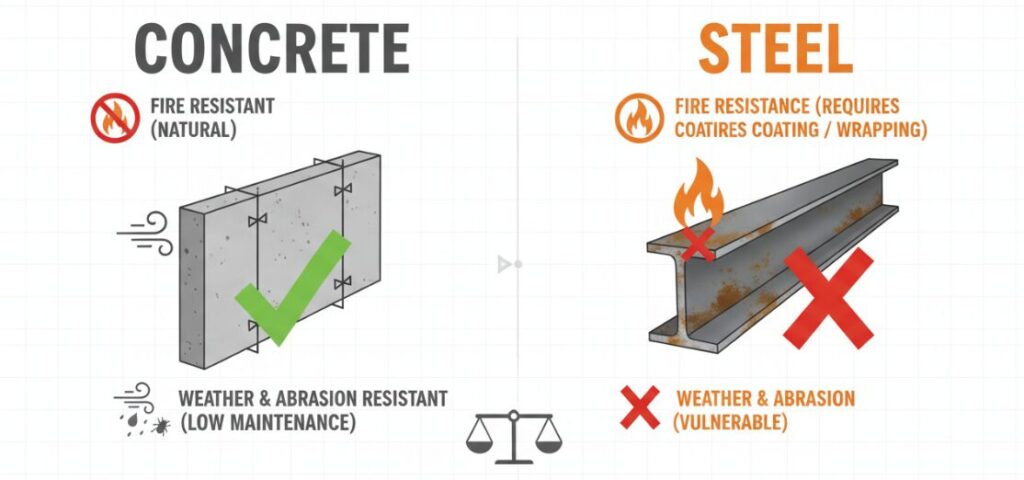
- Fire resistance: concrete is naturally fireproof and basically does not require additional treatment. However, steel does not work. Once bare steel encounters high temperature, its strength will drop very quickly, so it is usually necessary to spend a lot of money on fireproof coating or wrapping.
- Weather and abrasion resistance: concrete is extremely solid, resistant to wind, abrasion and even pest. As an exterior wall or foundation, it is basically a “low-maintenance” option and is not afraid of being lost in the open air.
Speed, Accuracy And Construction Efficiency
In addition to the hardness of the material itself, the “efficiency” in the construction process is actually invisible strength. Steel components are usually prefabricated in the factory with high precision, and the benefits of this step are obvious:
- Extremely fast construction: components are pulled to the site for direct assembly, which is much faster than on-site formwork pouring.
- Reduce waste: factory production can control the scrap very well, unlike concrete pouring and curing process, prone to material loss.
How To Make The Right Choice?
In the final analysis, judging whether structural steel is “stronger” than concrete depends entirely on the specific pain points of the project.
If you are looking for tensile, shear and the ultimate strength-to-weight ratio, especially when making super high-rise buildings or large-span structures, steel is the ideal choice. However, if your focus is on a solid foundation, natural fire resistance, and extremely high compression resistance, concrete is still an irreplaceable cornerstone.
Author:Mark Austin
Hi, I’m a structural engineer with over 17 years of experience in the construction industry. I specialize in structural analysis and material selection, helping architects and builders navigate the critical trade-offs between steel and concrete.