 GAOERJI STEEL


Search
How To Build A Steel Mezzanine
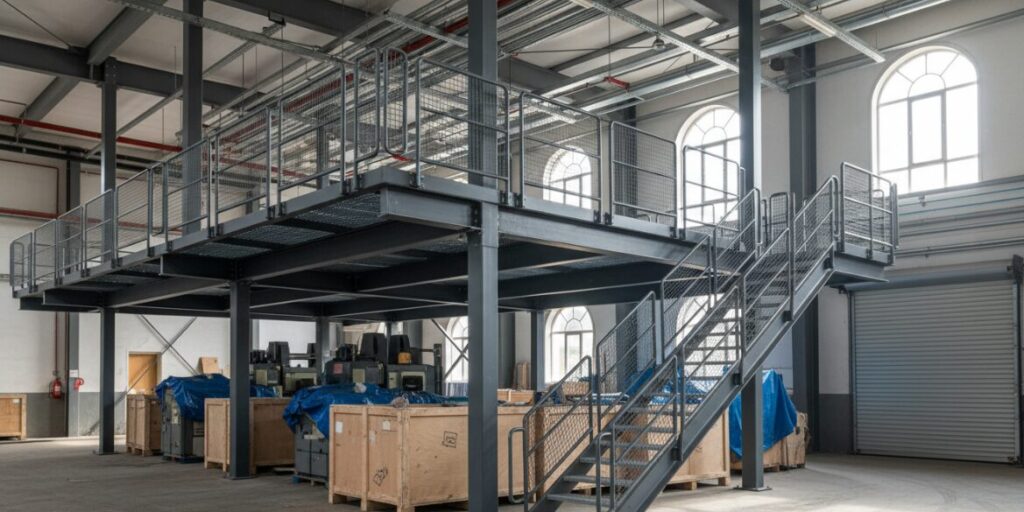
Building a steel mezzanine requires a blend of precise engineering and systematic installation to ensure code compliance and safety. The process generally follows these 6 key steps:
- Feasibility & Design: Verify your slab’s bearing capacity (typically 3,000+ PSI) and design the structure with PE-stamped drawings to meet IBC/OSHA standards.
- Permitting: Submit your engineering plans to local municipalities to secure necessary building permits before fabrication.
- Site Preparation: Clear the area and layout column locations using chalk lines to ensure the structure will be square.
- Column Installation: Anchor the steel columns to the concrete slab, ensuring they are plumb and temporarily braced.
- Framing Assembly: Bolt the main beams and joists to the columns to create the structural framework.
- Decking & Safety: Install the corrugated steel decking or flooring, followed by mandatory safety features like handrails, kickplates, and staircases.
Step 1: Feasibility And Design
The first step in learning how to build a steel sandwich, in fact, began long before the steel approach, the core is your concrete floor. You must verify that the existing ground can withstand the huge “point load” generated by the sandwich column “. Industry standards typically require a ground bearing capacity of at least 3,000 PSI. If the ground is not strong enough, we usually recommend to re-cast the independent foundation.
At this stage, the structural design must be done by a qualified engineer. The final output must be the drawing with PE seal (Professional Engineer, registered professional engineer), which is the blueprint of the project. These designs ensure that your structural steel mezzanine meets International Building Code (IBC) and Occupational Safety and Health Administration (OSHA) standards, especially in terms of load rating, headroom and escape routes.
Step 2: License Approval
Once the engineering drawings are finalized, the next step is to get a legal “construction license”. I must remind you that you should never start manufacturing or installation before submitting the stamped drawings to the local municipal department.
The permit approval process is to verify that your proposed structure complies with local zoning, fire and safety regulations. This step, while cumbersome, can avoid downtime or expensive fines later in the project due to violations. The municipal department will review the structural calculations and layouts provided during the design phase and issue a building permit after the review is approved. Only after obtaining the license can the physical manufacturing of steel components be officially started.
Steel Structure Workshop
Steel Structure Workshops offer versatile designs. Clear Span ensures unobstructed space, while Centre and Intermediate Columns provide economical solutions for wide spans.
Bridge/Steel Structure Bridgeipsum
Steel Structure Bridges utilize high strength-to-weight ratios to achieve long spans where intermediate supports are difficult.Their versatility makes them essential for critical infrastructure connectivity.
Steel Structure Buildings
Steel Structure Buildings feature versatile designs to meet diverse needs. Clear Span offers open space, while Centre and Intermediate Columns increase economy for large spans. Multi Gable accommodates complex widths.
Step 3: Site Preparation
Get the permit, the material comes in, and the real field work begins. First of all, the installation area must be thoroughly cleaned, there can be no obstacles, and space should be left for the safe movement of forklifts and scissor lifts.
The installation team then “reprints” the dimensions on the drawing onto the shop floor. This usually involves Chalk Lines to mark the exact center point of each column. Here I have to emphasize: the accuracy is not negotiable, the layout must be absolutely “square “. Experienced installers usually use the Pythagorean theorem (3-4-5 method) or laser calibration tools at this stage. The reason is very simple-if the line at the bottom is crooked, the beam and the plank above will not match at all when assembled.
Step 4: Column Installation
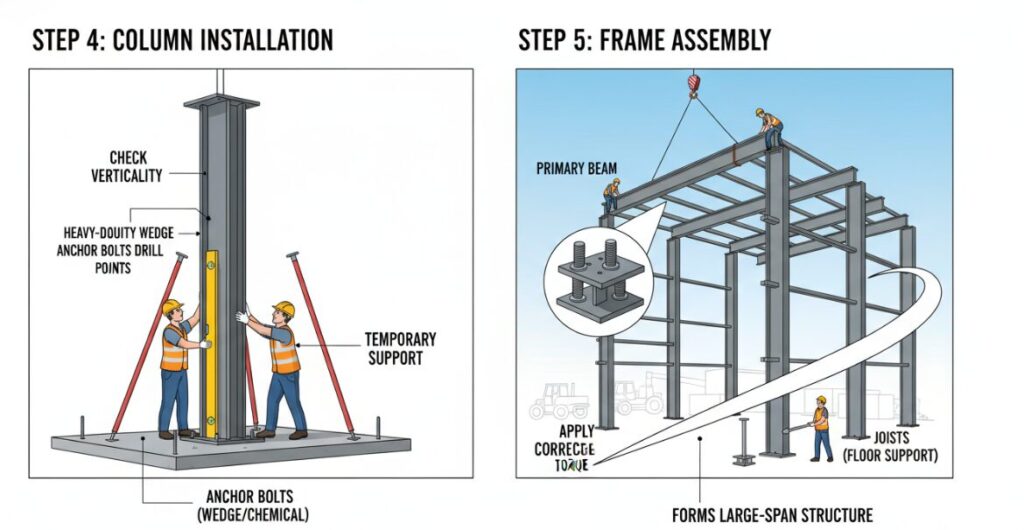
This is the key stage in the establishment of vertical support. Steel columns are placed on the ground at marked anchorage points. According to the requirements of the project specification, we will use heavy wedge anchor bolts or chemical anchor bolts to fix the column base plate to the ground.
In this process, each column must remain “vertical”, which is crucial. The installer will repeatedly check the verticality with a level. Since the columns are not connected to the beams at this time, they must be temporarily supported to prevent toppling or shaking. This laid a stable foundation for subsequent high-altitude operations.
Step 5: Frame Assembly
Once the columns are secured, the construction of the transverse frame begins. This step solves the core problem of “how to build a large-span structure. The main beam is hoisted in place and bolted to the top of the column or to the mounting plate.
Immediately after the main beams, joists are installed at a vertical angle to fill the gap between the main beams. This forms a grid-like framework to support the floor. High strength structural bolts shall be used for all connection points. The installer must apply the correct torque to these bolts to ensure that the connection is rigid enough to withstand the live and dead loads of the design.
Step 6: Plank And Safety Facilities
It was only in the final step of construction that the steel frame was truly transformed into usable workspace. Profiled steel plates (usually B- deck) are laid on the joists and fixed using self-tapping screws or plug welding. Depending on the design requirements, a decorative surface layer-such as high-density board, patterned steel plate or concrete-may be installed on top of this steel plate.
At the same time, the mandatory safety components must also be installed simultaneously. This includes stairs for going up and down, circumferential handrails to prevent falls, and skirting boards (Kickplates, usually 4 inches high) fixed to the bottom of the handrails-this is to prevent tools or materials from slipping and injuring people below. Once these safety features are in place and have passed final acceptance, the mezzanine is ready for use.
Author:Mark Reynolds
I am a Senior Structural Engineer specializing in industrial space optimization. With over 15 years of experience in warehouse logistics, I focus on designing and installing steel mezzanines that strictly adhere to IBC and OSHA standards.