 GAOERJI STEEL


Search
This high rise building steel structure is made of high-strength Q355B/Q460 low alloy steel and has structural stability with seismic fortification intensity above 8 degrees. Through 85% of factory prefabricated components, the on-site assembly cycle is shortened by 30%-50%, which is an ideal structural solution for super-high-rise commercial and residential projects with more than 30 floors,and supports for bulk purchases.
Q355B/ASTM A572
Material
fortification intensity 8 degrees
Seismic
≥ 345 MPa
Yield
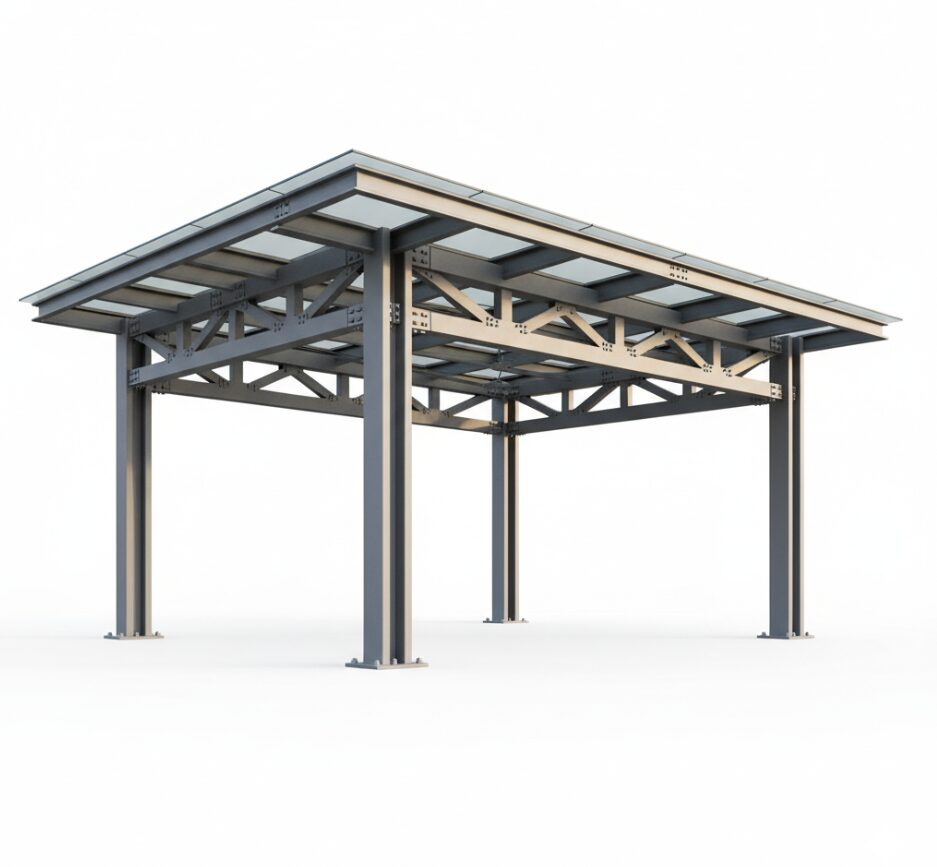

Choose Q355B or ASTM A572 Gr. 50 high strength low alloy structural steel, the yield strength of 345MPa or more. Compared with ordinary carbon steel, the cross-sectional size is reduced by 15%-20% under the same bearing capacity, which effectively supports the vertical load of high-rise buildings above 100 meters and ensures the service life of the main structure for more than 50 years.
Designed for high intensity seismic zones with a structural ductility ratio (Ductility Ratio) greater than 4.0. Under the action of strong earthquake, the seismic energy is absorbed by the plastic deformation of the steel, and the interlayer displacement angle is controlled within 1/250, which effectively prevents the brittle fracture of the structure and meets the requirements of UBC 97 or GB 50011 seismic code.
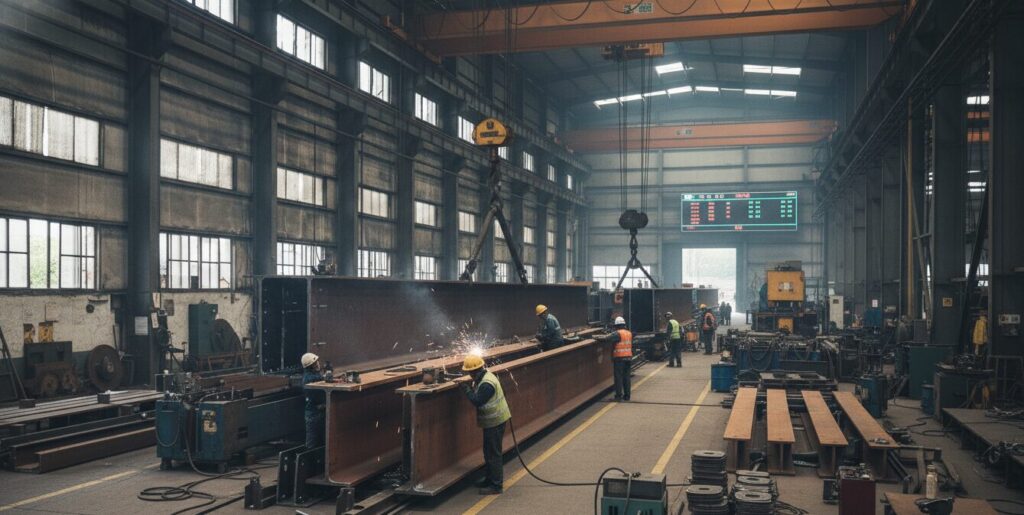
All components are CNC drilled and laser cut in the factory, with length tolerance controlled within ± 2mm and bolt hole distance tolerance controlled within ± 0.5mm. The high-precision processing ensures that the primary perforation rate of the on-site bolt connection reaches more than 98%, and avoids the delay of construction period and structural damage caused by on-site reaming.
Thanks to the high strength-to-weight ratio of high rise building steel structure, the cross-sectional area of steel columns is reduced by 30%-40% compared with traditional reinforced concrete columns. For office or apartment projects, this means that each floor can increase the effective use area (Net Carpet Area) by 5%-8%, significantly improving the return on investment.
The prefabrication rate of the component factory is as high as 85%, and only high-strength bolt connection and a small amount of welding are required on site. For a 30-story building, the construction speed of the main structure can reach 3 days/layer, which shortens the total construction period by 4-6 months compared with the concrete pouring structure, and greatly reduces the construction management cost and capital occupation cost.
The surface shall be derusted by sandblasting to Sa2.5 level, and shall be sprayed with epoxy zinc-rich primer and fire retardant coating. The system has a fire resistance limit of 3 hours (beam-column main structure) and passes 1000 hours of salt spray testing, ensuring durability in coastal or high humidity environments and reducing maintenance costs throughout the life cycle.
| Parameter item | Technical Specification |
| Product Name | High-rise building steel structure |
| Main steel grades | Q345B, Q355B, Q460C (compliant with GB/T 1591) or ASTM A572 Gr.50 |
| Structural form | Frame-core tube structure / Frame-braced structure / Concrete-steel tubular column (CFT) |
| Yield strength | ≥ 345 MPa (up to 460 MPa optional) |
| tensile strength | 470 – 630 MPa |
| Seismic fortification level | 8 degrees (0.20g) – 9 degrees (0.40g) |
| Wind load resistance | Basic wind pressure 0.75 kN/m², can withstand typhoons up to level 14. |
| Machining accuracy standards | AISC 303-16 / GB 50205-2020 |
| Welding quality level | The CJP (Complete Penetration Pour) weld meets the Ultrasonic Testing 100% standard. |
| Surface treatment | Sandblasting Sa2.5, epoxy zinc-rich primer (dry film thickness DFT ≥ 80μm) |
| Fire resistance limit | Main beams/columns ≥ 3.0 hours, secondary beams ≥ 2.0 hours (with fire-retardant coating) |
| Maximum span | 12m – 36m (Column-free space design) |
Compared with traditional reinforced concrete structure and ordinary steel structure, this high rise building steel structure mainly solves the following industry pain points:
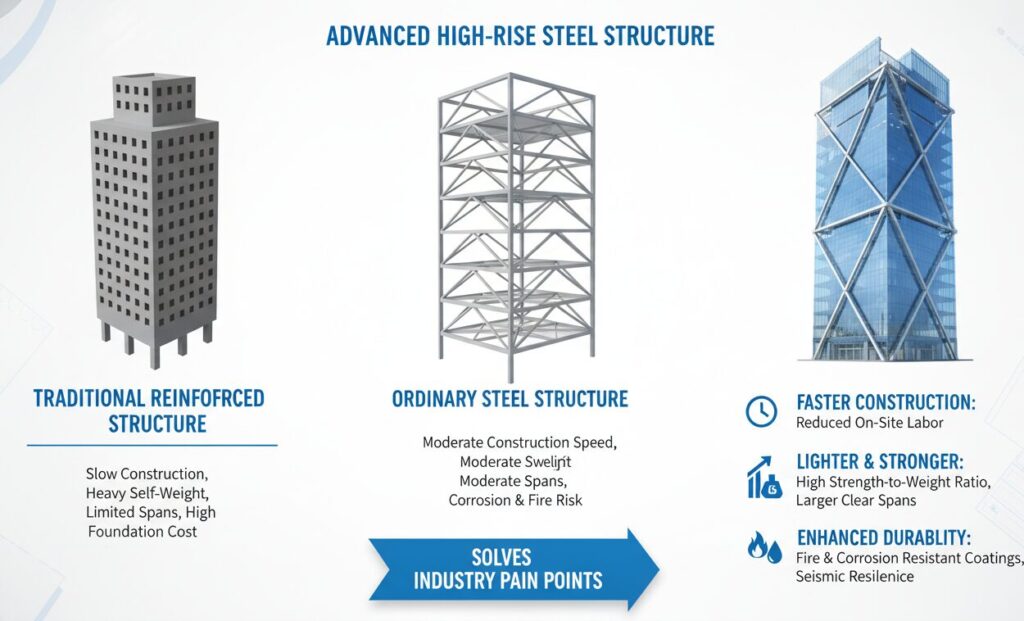

The traditional RC structure is limited by concrete curing time and formwork process, and the construction speed is slow. This product adopts fully prefabricated bolting technology to increase the construction speed to an average of 3 days/layer. For real estate developers, this means that the project can be paid back six months in advance, significantly easing the pressure on capital interest under the high turnover model.
High-rise concrete buildings have great deadweight and high requirements for foundation bearing capacity. The weight of the steel structure system is only 1/2 to 1/3 of the concrete structure of the same scale. The significantly reduced foundation load reduces the pile foundation engineering quantity by 20%-30%, which is especially suitable for the construction of high-rise buildings in soft soil foundation or complex geological conditions.
In order to meet the load-bearing requirements of high-rise buildings, ordinary structures often use huge concrete columns, which seriously encroach on indoor space. This product takes advantage of the small cross-section of high-strength steel, while ensuring the bearing capacity of 100 meters + height, reduces the occupied area of the structure by 40%, directly increases the rental or sales area of each floor, and solves the problem of space waste in the core area.
It is suitable for the construction of Grade A office buildings, five-star hotels or integrated commercial bodies with more than 30 floors. building the characteristics of large span and small section of steel structure, high rise can provide open office space without columns and flexible commercial layout, and maximize the rental value of commercial real estate.

For 100 meters to 500 meters high city landmark construction project. Such projects have extremely high requirements for construction accuracy and wind resistance. The industrialized precision manufacturing and high-grade seismic performance of this product are the core guarantee to ensure that super high-rise buildings are completed on schedule and pass the acceptance.

It is suitable for green buildings and prefabricated high-rise residential quarters promoted by the government. The high prefabrication rate of steel structures is used to meet the national requirements for assembly building scoring (such as assembly rate> 60%), while reducing noise and dust pollution on the construction site, and meeting green construction standards.

Applicable to the shortage of land resources, the need for “industrial upstairs” high-rise production workshop. The high bearing capacity (live load> 5.0 kN/m²) and long-span design of this product can meet the needs of heavy equipment and assembly line layout, and improve the utilization rate of industrial land.


Before concreting, use a high-precision total station to position the anchor bolts and ensure that the center deviation of the high rise building steel structure the anchor bolt group is <1.0mm. After the foundation concrete curing period expires, re-measure the elevation and adjust the nut to the design height to provide a horizontal benchmark for the installation of steel columns.

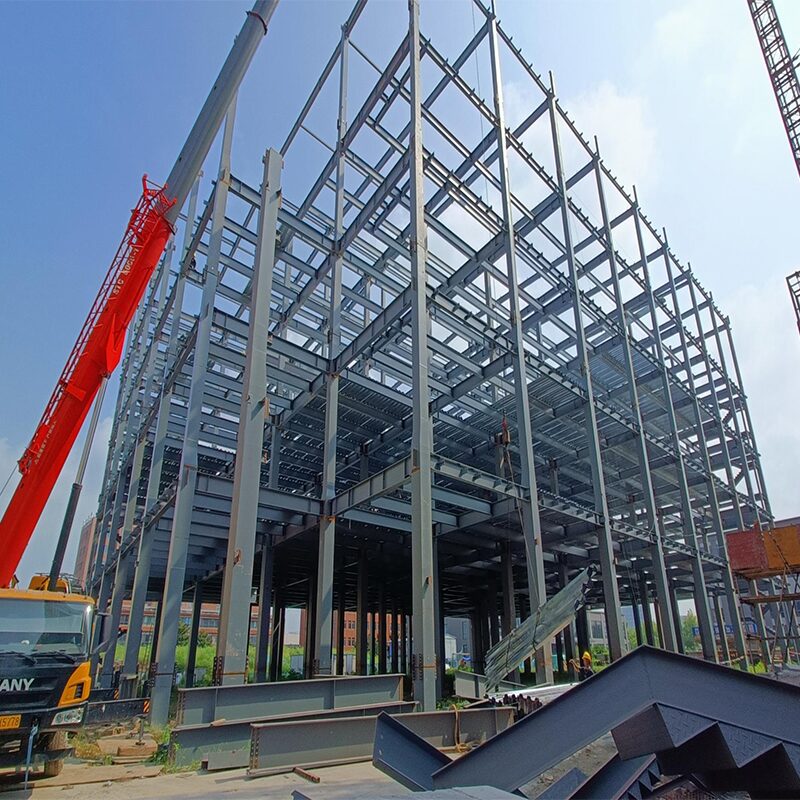
The first section of steel column is hoisted in place by tower crane and fixed by temporary connecting plate. Use theodolite to monitor the verticality from two orthogonal directions, control the verticality deviation within H/1000 and no more than 10mm through jack fine adjustment, and finally screw the anchor bolt after confirmation.

After the steel column is fixed, install the main beam and the secondary beam. First use the positioning pin to the hole, insert the high-strength bolt and tighten it initially. After a stable frame system is formed, use an electric torque wrench to tighten it in 3 steps of initial tightening, re-tightening and final tightening. The final tightening torque must meet the GB 50205 standard, and the torque shall be checked after 1 hour.

The floor bearing plate is laid on the steel beam, and after spot welding is fixed, the stud welding machine is used to penetrate the steel plate and weld the stud to the upper flange of the steel beam. The spacing of studs shall be strictly in accordance with the drawings to ensure that the steel beam and concrete floor form a combined effect and enhance the overall rigidity.

certificate
Welcome to our Frequently Asked Questions page. We have compiled answers to common questions you may have, hoping to provide you with clear and quick solutions. If you cannot find the information you need here, please feel free to contact our customer support team.
This high rise building steel structure is made of high-strength Q355B/Q460 low alloy steel and has structural stability with seismic fortification intensity above 8 degrees. Through 85% of factory prefabricated components, the on-site assembly cycle is shortened by 30%-50%, which is an ideal structural solution for super-high-rise commercial and residential projects with more than 30 floors,and supports for bulk purchases.
Material
Q355B/ASTM A572
Seismic
fortification intensity 8 degrees
Yield
≥ 345 MPa

Choose Q355B or ASTM A572 Gr. 50 high strength low alloy structural steel, the yield strength of 345MPa or more. Compared with ordinary carbon steel, the cross-sectional size is reduced by 15%-20% under the same bearing capacity, which effectively supports the vertical load of high-rise buildings above 100 meters and ensures the service life of the main structure for more than 50 years.
Designed for high intensity seismic zones with a structural ductility ratio (Ductility Ratio) greater than 4.0. Under the action of strong earthquake, the seismic energy is absorbed by the plastic deformation of the steel, and the interlayer displacement angle is controlled within 1/250, which effectively prevents the brittle fracture of the structure and meets the requirements of UBC 97 or GB 50011 seismic code.
All components are CNC drilled and laser cut in the factory, with length tolerance controlled within ± 2mm and bolt hole distance tolerance controlled within ± 0.5mm. The high-precision processing ensures that the primary perforation rate of the on-site bolt connection reaches more than 98%, and avoids the delay of construction period and structural damage caused by on-site reaming.
Thanks to the high strength-to-weight ratio of high rise building steel structure, the cross-sectional area of steel columns is reduced by 30%-40% compared with traditional reinforced concrete columns. For office or apartment projects, this means that each floor can increase the effective use area (Net Carpet Area) by 5%-8%, significantly improving the return on investment.
The prefabrication rate of the component factory is as high as 85%, and only high-strength bolt connection and a small amount of welding are required on site. For a 30-story building, the construction speed of the main structure can reach 3 days/layer, which shortens the total construction period by 4-6 months compared with the concrete pouring structure, and greatly reduces the construction management cost and capital occupation cost.
The surface shall be derusted by sandblasting to Sa2.5 level, and shall be sprayed with epoxy zinc-rich primer and fire retardant coating. The system has a fire resistance limit of 3 hours (beam-column main structure) and passes 1000 hours of salt spray testing, ensuring durability in coastal or high humidity environments and reducing maintenance costs throughout the life cycle.
| Parameter item | Technical Specification |
| Product Name | High-rise building steel structure |
| Main steel grades | Q345B, Q355B, Q460C (compliant with GB/T 1591) or ASTM A572 Gr.50 |
| Structural form | Frame-core tube structure / Frame-braced structure / Concrete-steel tubular column (CFT) |
| Yield strength | ≥ 345 MPa (up to 460 MPa optional) |
| tensile strength | 470 – 630 MPa |
| Seismic fortification level | 8 degrees (0.20g) – 9 degrees (0.40g) |
| Wind load resistance | Basic wind pressure 0.75 kN/m², can withstand typhoons up to level 14. |
| Machining accuracy standards | AISC 303-16 / GB 50205-2020 |
| Welding quality level | The CJP (Complete Penetration Pour) weld meets the Ultrasonic Testing 100% standard. |
| Surface treatment | Sandblasting Sa2.5, epoxy zinc-rich primer (dry film thickness DFT ≥ 80μm) |
| Fire resistance limit | Main beams/columns ≥ 3.0 hours, secondary beams ≥ 2.0 hours (with fire-retardant coating) |
| Maximum span | 12m – 36m (Column-free space design) |
The traditional RC structure is limited by concrete curing time and formwork process, and the construction speed is slow. This product adopts fully prefabricated bolting technology to increase the construction speed to an average of 3 days/layer. For real estate developers, this means that the project can be paid back six months in advance, significantly easing the pressure on capital interest under the high turnover model.
High-rise concrete buildings have great deadweight and high requirements for foundation bearing capacity. The weight of the steel structure system is only 1/2 to 1/3 of the concrete structure of the same scale. The significantly reduced foundation load reduces the pile foundation engineering quantity by 20%-30%, which is especially suitable for the construction of high-rise buildings in soft soil foundation or complex geological conditions.
In order to meet the load-bearing requirements of high-rise buildings, ordinary structures often use huge concrete columns, which seriously encroach on indoor space. This product takes advantage of the small cross-section of high-strength steel, while ensuring the bearing capacity of 100 meters + height, reduces the occupied area of the structure by 40%, directly increases the rental or sales area of each floor, and solves the problem of space waste in the core area.
It is suitable for the construction of Grade A office buildings, five-star hotels or integrated commercial bodies with more than 30 floors. building the characteristics of large span and small section of steel structure, high rise can provide open office space without columns and flexible commercial layout, and maximize the rental value of commercial real estate.
For 100 meters to 500 meters high city landmark construction project. Such projects have extremely high requirements for construction accuracy and wind resistance. The industrialized precision manufacturing and high-grade seismic performance of this product are the core guarantee to ensure that super high-rise buildings are completed on schedule and pass the acceptance.
It is suitable for green buildings and prefabricated high-rise residential quarters promoted by the government. The high prefabrication rate of steel structures is used to meet the national requirements for assembly building scoring (such as assembly rate> 60%), while reducing noise and dust pollution on the construction site, and meeting green construction standards.
Applicable to the shortage of land resources, the need for “industrial upstairs” high-rise production workshop. The high bearing capacity (live load> 5.0 kN/m²) and long-span design of this product can meet the needs of heavy equipment and assembly line layout, and improve the utilization rate of industrial land.
Before concreting, use a high-precision total station to position the anchor bolts and ensure that the center deviation of the high rise building steel structure the anchor bolt group is <1.0mm. After the foundation concrete curing period expires, re-measure the elevation and adjust the nut to the design height to provide a horizontal benchmark for the installation of steel columns.
The first section of steel column is hoisted in place by tower crane and fixed by temporary connecting plate. Use theodolite to monitor the verticality from two orthogonal directions, control the verticality deviation within H/1000 and no more than 10mm through jack fine adjustment, and finally screw the anchor bolt after confirmation.
After the steel column is fixed, install the main beam and the secondary beam. First use the positioning pin to the hole, insert the high-strength bolt and tighten it initially. After a stable frame system is formed, use an electric torque wrench to tighten it in 3 steps of initial tightening, re-tightening and final tightening. The final tightening torque must meet the GB 50205 standard, and the torque shall be checked after 1 hour.
The floor bearing plate is laid on the steel beam, and after spot welding is fixed, the stud welding machine is used to penetrate the steel plate and weld the stud to the upper flange of the steel beam. The spacing of studs shall be strictly in accordance with the drawings to ensure that the steel beam and concrete floor form a combined effect and enhance the overall rigidity.