
 GAOERJI STEEL


Search
What Is A Prefabricated Building
A prefabricated building (often called a “prefab”) is a structure whose primary components—such as walls, roof sections, and structural frames—are precision-manufactured in a controlled factory setting before being transported to the site for rapid assembly. This offsite construction method significantly improves quality control and reduces construction timelines by 30% to 50% compared to traditional methods. From residential homes to massive industrial warehouses, prefabricated buildings offer a cost-effective, sustainable, and code-compliant solution for modern infrastructure.
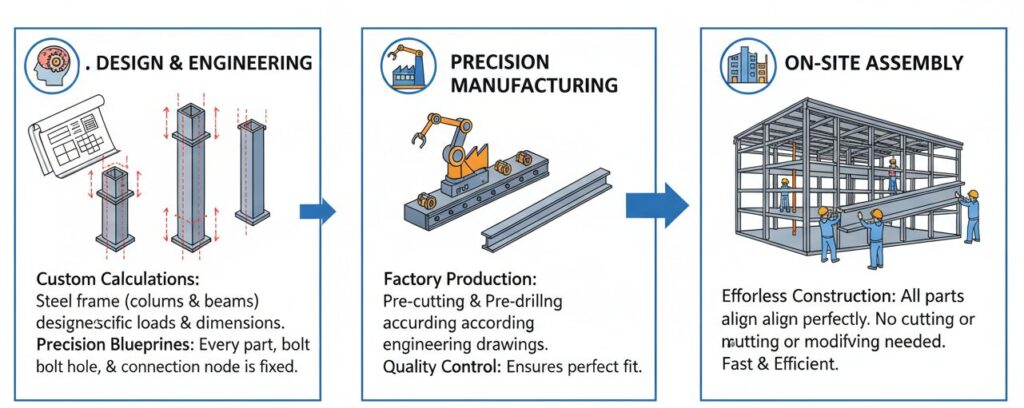
Precision Manufacturing Of Prefabricated Parts
The core soul of prefabricated building lies in its factory production. the materials of traditional building construction are exposed to the wind and the sun, and there are too many variables. The prefabrication is done in a constant temperature and humidity factory, which essentially changes the precision of the building.
- Engineering design accuracy: we will use advanced CAD (computer aided design) software, the parameters of each component is accurate to the millimeter level.
- Controlled environment: The biggest benefit of manufacturing indoors is to avoid the risk of moisture attack, wood warping or metal corrosion. This method of eliminating hidden quality hazards from the source is much better than repairing and mending on the construction site later.
- Diversity of components: The technology is now very mature, from single panel systems to modular units throughout the room, which can be highly customized.
Reasons For The Speed Increase
In the current market environment, the duration directly determines the return on investment. The reason why prefabricated buildings are fast is that they achieve “parallel processing” that traditional construction simply cannot do “.
- Synchronous construction: When workers excavate the foundation and pour the foundation on site, the structural frame and wall in the factory have already started production simultaneously. This is what traditional construction site dare not imagine.
- Lightning assembly: After the components arrive at the site, they can be capped in a few days or weeks by bolting or welding, instead of spending more than half a year.
- Farewell to work stoppages: Since most of the work is done under the eaves, the nasty rainy season or cold weather is hardly a threat to work stoppages, and the probability of budget overruns is greatly reduced.
Quality Control And Cost Efficiency
In terms of structural strength and durability, prefabricated buildings are often more reliable than traditional buildings, mainly due to their standardized production logic:
- Standardized quality inspection: every process of the factory assembly line has strict quality inspection, and every seam and seal must meet the standards.
- Material utilization: Precise cutting means extremely low waste. In my experience, this increase in material efficiency translates directly into real money in the pockets of developers and end users.
- Manpower optimization: In factories, skilled workers are much more efficient than in remote sites, eliminating the cost of large-scale personnel transportation.
The Infinite Possibilities Of Application Scenarios
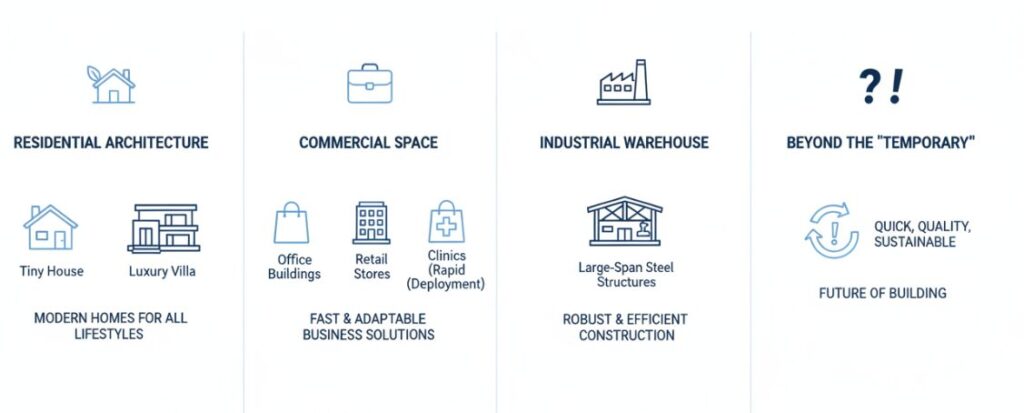
Now the “prefabricated” is no longer limited to temporary simple houses. Its applications include:
- Residential architecture: from the minimalist house (Tiny House) to the luxury multi-storey villa full of design, you can easily.
- Commercial space: Office buildings, retail stores and even temporary clinics that can be deployed quickly.
- Industrial warehouse: this kind of steel structure buildings with large span and high requirements for structural integrity are basically assembled at present.
Sustainability And Building Codes
With the transformation of the industry to “green building”, assembly technology is clearly on the cusp.
- Environmentally friendly: Less on-site waste, coupled with the extensive use of recyclable structural steel, the carbon footprint is naturally smaller.
- Energy efficiency performance: the thermal insulation layer and high-precision matching components pre-installed in the factory make the building more airtight, and the long-term air conditioning and heating costs can save a lot.
- Compliance: Modern prefabricated buildings are designed to fully comply with, and even exceed, local and international building codes. Whether it’s fire protection, earthquake resistance or extreme weather resistance, they are very strong.
Author:Cook
“I’m a construction technology specialist with over a decade of experience in industrial design, and I’m passionate about how prefabricated buildings are revolutionizing the industry through precision engineering and sustainable practices. I want to help developers and homeowners understand the efficiency and cost-saving potential of modern modular solutions.”
