
 GAOERJI STEEL


Search
What Are The Typical Uses Of Structural Steel
From the load-bearing framework of skyscrapers, to large industrial warehouses, to the amazing span of bridges and commercial complexes, there are steel structures everywhere. The reason why everyone loves to use it, in the final analysis, is because of its amazing yield strength and tensile strength, coupled with the standard profiles of H-beam and I-beam, it is really convenient to use. In large-scale projects, whether compared to concrete or wood, structural steel is indeed an impeccable balance between durability, cost and design flexibility. Usually we will look at the selection of ASTM standards, such as A992 or A36, which has almost become the general language of engineering.
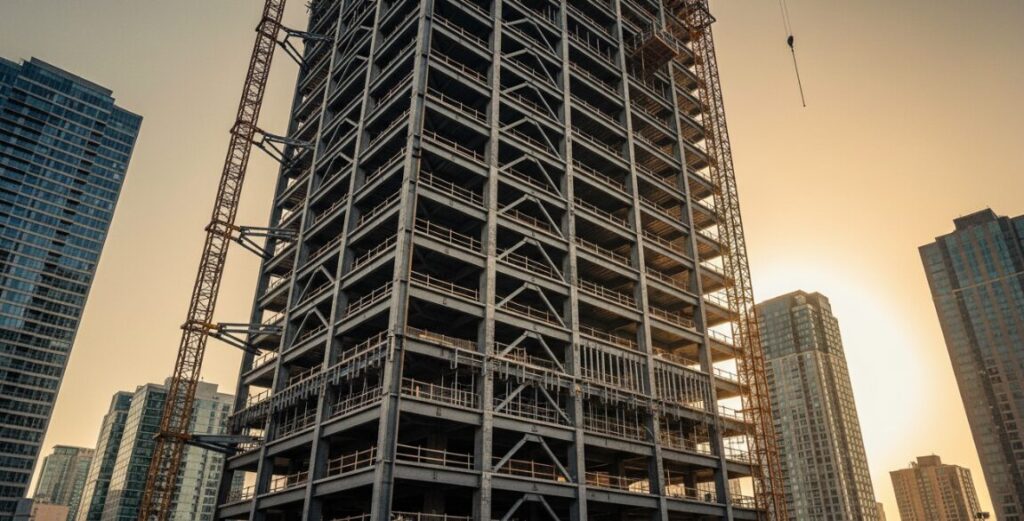
Skyscrapers: The Support Point Of Urban Vertical Growth
In the pursuit of building height today, structural steel is the only choice. It has a high strength-to-weight ratio, which allows architects to build extremely high buildings without crushing the foundation due to excessive self-weight.
Seismic performance: The ductility of steel is life-saving. In the event of an earthquake, steel structures absorb and dissipate energy, which is essential to prevent a devastating collapse of the building.
Space flexibility: By using H-shaped steel and W-shaped steel sections, we can easily achieve the kind of large-span, column-free internal space, which is very effective for maximizing the utilization required by the owner.
Industrial Warehousing And Prefabrication Efficiency
In industrial projects, everyone is most concerned about the construction period and cost. In this regard, the prefabrication advantage of structural steel is very obvious.
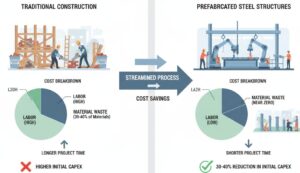
Construction speed: The components are accurately processed in the factory according to ASTM standards (such as A992) and transported to the site for direct hoisting, which is much faster than pouring concrete on site. After all, the current project capital turnover pressure is very high.
Advantages of large span: thanks to I-beam, it can support ultra-long column-free span, which is almost just needed for logistics centers or production workshops that accommodate heavy machinery.
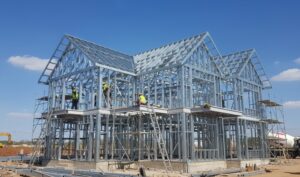
Steel Structure Workshop
Steel Structure Workshops offer versatile designs. Clear Span ensures unobstructed space, while Centre and Intermediate Columns provide economical solutions for wide spans.
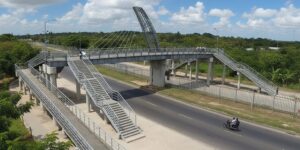
Bridge/Steel Structure Bridgeipsum
Steel Structure Bridges utilize high strength-to-weight ratios to achieve long spans where intermediate supports are difficult.Their versatility makes them essential for critical infrastructure connectivity.
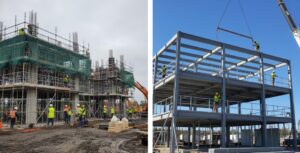
Steel Structure Buildings
Steel Structure Buildings feature versatile designs to meet diverse needs. Clear Span offers open space, while Centre and Intermediate Columns increase economy for large spans. Multi Gable accommodates complex widths.
Bridge Infrastructure
Bridges are faced with continuous dynamic loads and various harsh climates, and the most stable must be selected.
Bearing capacity: whether it is a truss bridge or a suspension bridge, the high tensile strength of structural steel can minimize the weight load of the substructure while crossing the huge gap.
Controllable performance: We insist on using standard steel such as ASTM A36 or A992 to ensure that the structural integrity and performance of the bridge is predictable throughout its life cycle.
Commercial Complex
Modern commercial centers need to be good-looking and able to support all kinds of strange architectural geometric shapes.
Design flexibility: compared with wood or traditional reinforced concrete, steel structure is too good to change. It can be easily integrated with a glass curtain wall or metal shell, which is why today’s shopping malls look so modern.
Economy: Don’t look at the unit price of steel does not seem to be low, if you count the shortening of the construction cycle, as well as because of the light weight and save the foundation cost, in large projects, structural steel is often the best cost-effective choice.

Why Steel Structure Is Always The First Choice
By combining ASTM-level accuracy (such as A992/A36) with flexible cross-sections such as H-beams and I-beams, it shapes our urban skylines today. It can not only withstand earthquakes, but also achieve rapid construction. As long as these engineering needs are still there, the status of structural steel as the cornerstone of the project will not be shaken.
Author: Alex Sterling
I am a structural engineer with over 13 years of experience in the construction industry. Throughout my career, I have overseen the development of diverse projects, ranging from soaring commercial skyscrapers to critical infrastructure bridges. My passion lies in bridging the gap between complex engineering standards—like ASTM requirements—and practical, cost-effective architectural design.
Related recommendations
-

Are Steel Buildings Cost Effective
30Learn Why Steel Buildings Offer Superior ROI Through Low Maintenance, Insurance Savings, And Faster Construction.
View details -
Do Steel Frame Homes Rust
200Modern Steel Frames Are Rust-Proof For 50-100 Years. Learn How Advanced Coatings Protect Your Home In Any Climate.
View details -
Is Steel Structure Cheaper Than Concrete
22Save 30% On Labor And Finish Months Faster. Learn Why Steel Offers A Higher ROI Than Concrete For Your Next Project.
View details -
How Steel Buildings Can Save Money
198Learn How Steel Buildings Can Save Money: Cut Build Costs By 40%, Lower Insurance Premiums, And Maximize Usable Space.
View details

HelloPlease log in