
 GAOERJI STEEL


Search
Is Structural Steel Stronger Than Concrete
Simply put, structural steel is indeed much stronger than concrete.
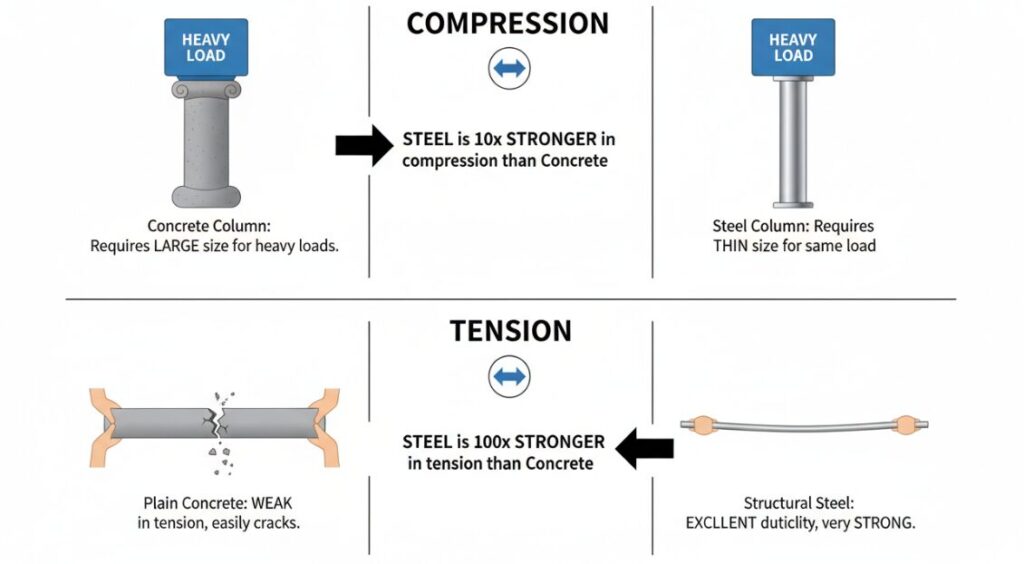
Whether we are talking about tensile or compressive properties of raw materials, the performance of steel is overwhelming. The compressive strength of structural steel is about 10 to 15 times that of standard concrete, and the tensile strength is more than 100 times that of plain concrete (unreinforced concrete).
This large strength difference gives the steel a very high “strength-to-weight ratio”. This means that we can design structures that are lighter, taller, and even slimmer. However, although steel has won the pure “strength” index, but this does not mean that we will abandon concrete. When dealing with foundations or large load-bearing walls, concrete is still an irreplaceable choice due to its cost-effectiveness and huge self-weight .
So in modern engineering practice, I rarely choose simply because of “who is stronger”. More often, we combine the two-using steel to strengthen concrete-to take advantage of their respective best properties.
Understanding Strength Indicators
In structural engineering, the two forces we are most concerned about are tension and pressure.
Excellent Compressive Capacity
The compressive strength of structural steel is more than ten times that of concrete. The so-called compression resistance is the ability of the material to withstand the downward extrusion load.
Although concrete is known in the industry for its resistance to compression (which is why it is used for heavy foundations), from a microphysical point of view, steel is denser and can withstand much greater PSI (pounds per square inch) before failure. This leads to a very intuitive phenomenon: a thin steel column can support the weight that would have required a huge concrete column to carry.
Unmatched Tensile Strength
The most dramatic gap between the two is actually reflected in the tensile strength.
The pulling force is the force that pulls the material toward both ends. Plain concrete is notoriously “brittle” and is easy to crack if it is pulled a little 1. In contrast, structural steel has excellent ductility and is very tensile-more than 100 times stronger than plain concrete. Steel is almost a must when designing structures such as beams or suspension bridges that face bending and pulling forces at all times.
Steel Structure Workshop
Steel Structure Workshops offer versatile designs. Clear Span ensures unobstructed space, while Centre and Intermediate Columns provide economical solutions for wide spans.
Bridge/Steel Structure Bridgeipsum
Steel Structure Bridges utilize high strength-to-weight ratios to achieve long spans where intermediate supports are difficult.Their versatility makes them essential for critical infrastructure connectivity.
Steel Structure Buildings
Steel Structure Buildings feature versatile designs to meet diverse needs. Clear Span offers open space, while Centre and Intermediate Columns increase economy for large spans. Multi Gable accommodates complex widths.
Absolute Advantage Of Strength-To-Weight Ratio
Because steel is so strong per unit volume, it has a very high strength-to-weight ratio. This is a decisive factor in modern architecture-especially in skyscrapers and large-span structures.
- Lighter structure: In order to support the same load, the design weight of the steel structure will be much smaller than the concrete structure.
- Taller, slimmer design: This high ratio allows engineers to make buildings taller and more upright. Using steel, the columns can be made very small and the column spacing can be pulled very large, so as to maximize the open space in the room-if it were replaced by concrete, those spaces would have been occupied by thick support columns. Up.
Since Steel Is Rolled In All Directions, Why Is Concrete Still Used?
If steel wins in every strength index, why do we still use concrete? The answer lies in the special needs of foundation engineering and the practical problem that cannot be avoided: cost.
Although steel wins in “pure strength”, concrete has more advantages in the following two aspects:
- The “self-weight” required by the foundation: When making the foundation, we often need to rely on the weight of the structure itself to “press” the building firmly on the ground. Concrete can provide this necessary volume at a very low cost, which steel cannot do.
- Cost-effectiveness: Imagine using pure steel to fill a large retaining wall or a huge foundation slab, the cost would be astronomical. Concrete provides an “adequate” compressive solution and is economical for large volume applications.
Steel-Concrete Combination
Ultimately, the question of whether structural steel is stronger than concrete leads to a compromise engineering solution.
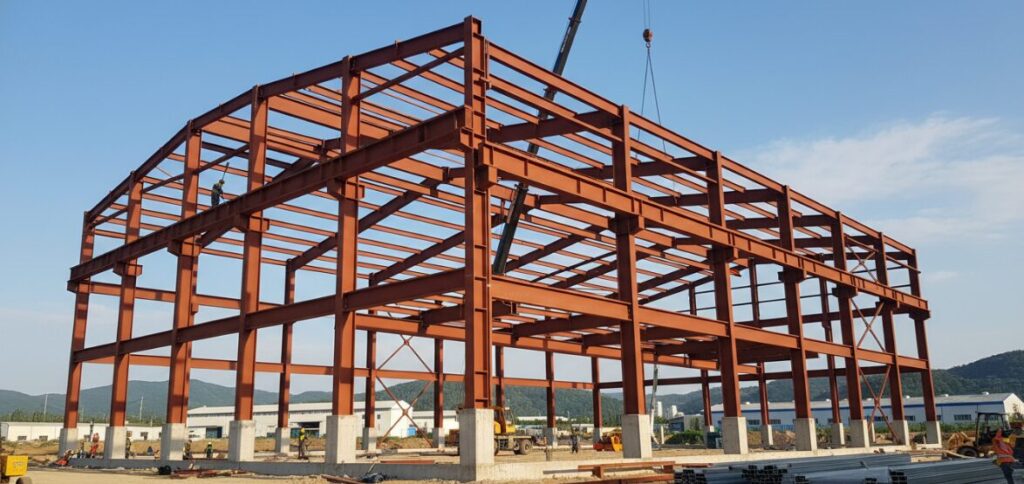
Since steel is good at tensile and compressive strength, and concrete provides cheap compressive strength, modern engineering usually combines them-this is reinforced concrete (Reinforced Concrete, RC).
By burying the rebar in the concrete, we have created a composite material, which truly achieves a “strong-strong combination”: the concrete is responsible for providing the volume and bearing the main pressure, while the rebar is internally “reinforced” to prevent the concrete from cracking under tension.
To sum up, although structural steel is undoubtedly stronger from the scientific data, the most stable structures we build often rely on the symbiotic relationship of these two materials.
Author:Mark Davis
As a structural engineering consultant with over a decade of experience in commercial construction, I specialize in analyzing material properties. My work focuses on the practical applications of structural steel and reinforced concrete, ensuring structures achieve the perfect balance of strength, mass, and durability.
