
 GAOERJI STEEL


Search
Is Steel Framed Building Earthquake Resistant
To answer you directly and simply: Yes.
Steel buildings are not only excellent in seismic performance, but are often considered one of the safest options in earthquake zones. Unlike concrete, which is prone to brittle cracking, the unique high ductility of steel allows the building structure to “discharge force” through bending deformation during severe ground shaking, instead of directly breaking or collapsing.
In addition, from a physical point of view, steel has a very high strength-to-weight ratio. This means that a steel house is lighter than a heavy masonry structure, which significantly reduces the inertial forces acting on the house during an earthquake. If you put the safety of your family first, in high-earthquake areas, a properly engineered steel frame system can indeed provide the highest level of structural integrity and toughness currently available.
The Role Of Ductility In The Earthquake Zone
To truly understand why steel structures are seismic, we have to talk about the aforementioned core of materials science-ductility.
When an earthquake occurs, the movement of the ground is violent and unpredictable. Materials such as unreinforced concrete or masonry are classified as “brittle materials” in engineering “. Once the impact of the shock wave exceeds their limit, they will suddenly break or shatter, this is the main reason for the catastrophic wall collapse of traditional houses in earthquakes.
But steel behaves completely differently. Steel has high ductility. This means that when it is subjected to the huge lateral force of the earthquake, the steel member will undergo “plastic deformation”. You can think of it as a paper clip: you can bend it back and forth many times and it won’t break. Used in buildings, this feature allows the steel frame to bend like a spring, absorbing and dissipating the energy of an earthquake. The frame may bend, but it still maintains its carrying capacity and prevents the building from collapsing directly on the occupants.
Steel Structure Workshop
Steel Structure Workshops offer versatile designs. Clear Span ensures unobstructed space, while Centre and Intermediate Columns provide economical solutions for wide spans.
Bridge/Steel Structure Bridgeipsum
Steel Structure Bridges utilize high strength-to-weight ratios to achieve long spans where intermediate supports are difficult.Their versatility makes them essential for critical infrastructure connectivity.
Steel Structure Buildings
Steel Structure Buildings feature versatile designs to meet diverse needs. Clear Span offers open space, while Centre and Intermediate Columns increase economy for large spans. Multi Gable accommodates complex widths.
Strength-To-Weight Ratio: Reducing Seismic Inertia
The second major factor in confirming the seismic resistance of steel structures is inertia in physics.
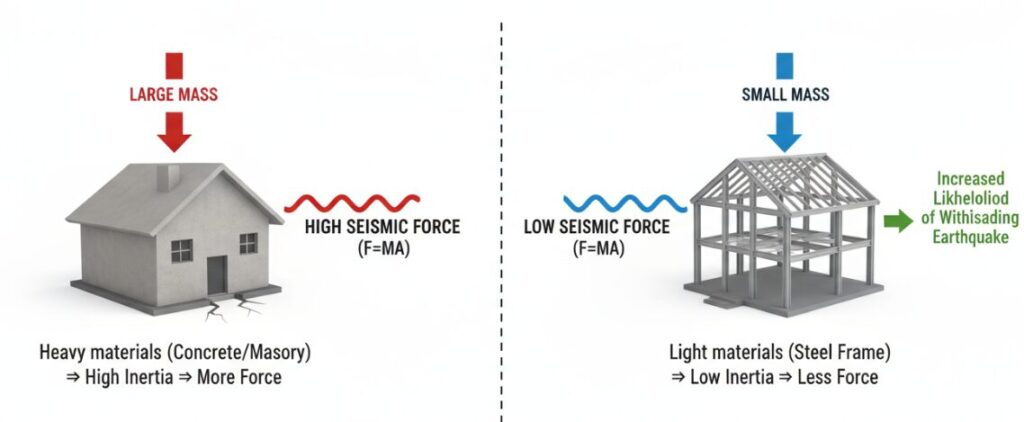
We all know Newton’s second law (F=ma), force is equal to mass multiplied by acceleration. In an earthquake, “acceleration” is the shaking of the ground, and “mass” is your house. The logic is simple: the heavier the house, the more seismic forces it must withstand.
Masonry and concrete are very heavy materials. Houses built with these materials will generate huge inertial loads during earthquakes, attracting stronger seismic forces, which tend to tear the structure apart. On the other hand, the steel frame, has a very high strength-to-weight ratio. On the premise of providing equal or even higher strength, the steel frame is much lighter than the concrete structure. Because the building becomes lighter, the seismic force acting on it also decreases in a cliff-like manner. This reduction in force directly reduces the pressure on the connecting nodes and the foundation, further increasing the probability that the house will be unscathed in the disaster.
Structural Integrity And Ductility Versus Brittle Failure
When the owners ask “is the steel structure earthquake resistant?”, in the final analysis, they ask about the survival rate and toughness.
The steel provides the “highest level of structural integrity” because a properly designed steel frame operates as a Cohesive Unit. In the traditional masonry structure, bricks and other independent components are all bonded by mortar, and violent shaking can easily break these connections, resulting in the disintegration of the wall.
In contrast, a steel frame uses a clear load path to safely conduct seismic energy underground. Because steel does not have the “brittle failure” of concrete, its performance is predictable. Even in the rare event of a magnitude 8 earthquake, the building may suffer permanent deformation (bending), but the steel frame is designed to ensure that it still stands. This concept is known in the industry as “Life Safety Performance”-ensuring that the primary goal is achieved: preventing collapses and protecting the safety of those inside.
Author:Mark Stevenson
“As a Senior Structural Engineer with over 15 years of experience in seismic construction, I specialize in analyzing building materials. I am passionate about helping homeowners understand why steel framing offers the ultimate structural integrity and safety in earthquake-prone areas.”
