
 GAOERJI STEEL


Search
Is Steel Frame Non Combustible
That’s right, steel frames are clearly classified as “non-combustible material” in the building code. From the point of view of our structural engineering, steel itself does not catch fire, does not burn, and does not provide additional “fuel” to the fire like wood “. Therefore, in terms of innate properties, steel frames are indeed much safer than wood structures, which are combustible materials. But I must start with a warning: in actual construction projects, do not confuse the two concepts of “incombustibility” and “fire-resistance rating. Although steel itself cannot burn, its structural integrity-especially its yield strength-falls precipitously at high temperatures. When the temperature reaches 600°C (about 1100 °F), the steel will lose about 50% of its bearing capacity. Therefore, in order to achieve a specific fire resistance rating, we usually have to use passive fire protection measures such as intumescent paint, mineral wool insulation or gypsum board cladding to ensure that the structure will not collapse instantaneously in a fire and comply with NFPA and local codes.
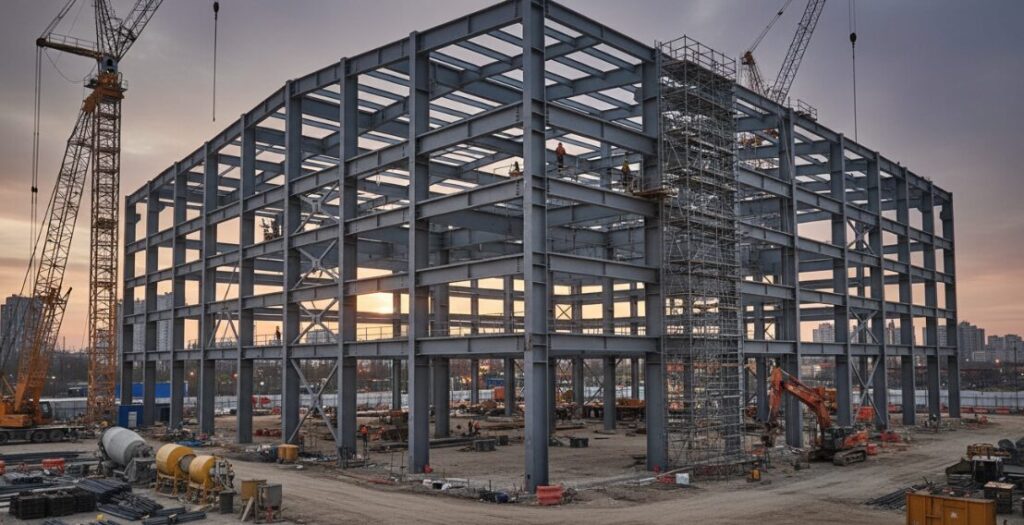
How To Define The “Incombustibility” Of Steel “
In the context of the International Building Code (IBC) and NFPA standards, a material is considered “non-combustible” if it does not ignite under the expected conditions and does not support combustion “. Steel, as the inorganic alloy, fully meets these criteria. Unlike wood or some engineering plastics, steel does not increase the “fire load” of a building “. If there is a fire inside the building, the steel frame will not participate in the combustion, and it will not cause the flame to spread quickly in the structural cavity or frame. This is a huge engineering advantage in preventing rapid fire expansion.
Steel Structure Workshop
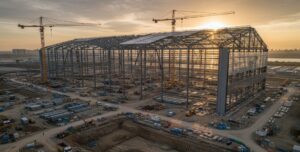
Steel Structure Workshops offer versatile designs. Clear Span ensures unobstructed space, while Centre and Intermediate Columns provide economical solutions for wide spans.
Bridge/Steel Structure Bridgeipsum
Steel Structure Bridges utilize high strength-to-weight ratios to achieve long spans where intermediate supports are difficult.Their versatility makes them essential for critical infrastructure connectivity.
Steel Structure Buildings
Steel Structure Buildings feature versatile designs to meet diverse needs. Clear Span offers open space, while Centre and Intermediate Columns increase economy for large spans. Multi Gable accommodates complex widths.
“Non-Burning” Is Not Equal To “Fire Prevention”
There is a common misconception in engineering circles that “non-burning” means that the house is “fireproof” (fireproof). This is far from the truth. Although steel is “non-combustible,” the “fire rating” measures how long the entire component (such as a wall, a floor or a column) maintains structural function in the event of a fire (such as a 1-hour, 2-hour or 4-hour rating). The key to the problem is that the heat conduction speed of steel is extremely fast. Steel beam without any protection will quickly reach the critical temperature in the fire scene. Once it gets to that point, it can’t support the design load. Therefore, even if the material itself is safe and cannot be burned, the entire structural system still needs additional “soft armor” to meet the rigid requirements of modern building codes for life safety.
Dimensionality Reduction Blow Of High Temperature On Yield Strength Of Steel
The core challenge faced by steel frames in fires has never been “fire risk”, but the loss of mechanical properties. As long as structural steel is exposed to environments above 400°C (750 °F), its yield strength and stiffness begin to decline. Once steel reaches around 600°C, it is only half as strong. At this stage, the risk of substantial deflection or even overall collapse of the structure increases. This thermal sensitivity is why we structural engineers put heat management a high priority when designing steel buildings.
Passive Fire Protection (PFP) Strategy For Steel Structures
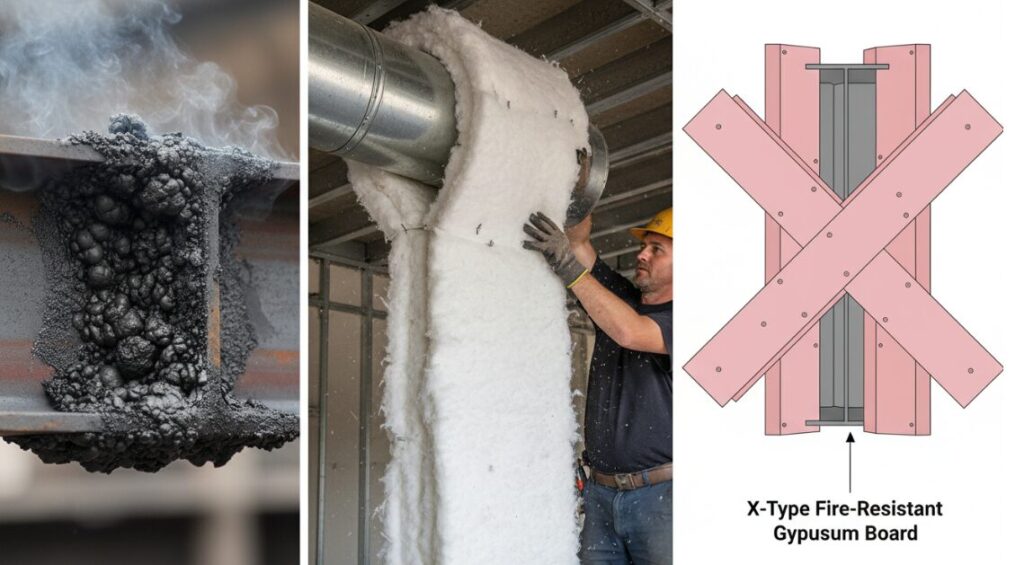
In order to make up for the steel “non-combustible” but not “fire-resistant” congenital short board, we will use passive fire prevention measures. These measures are equivalent to insulating the steel to ensure that the temperature of the steel remains below the critical failure threshold for a predetermined period of time:
- Intumescent coating: This is the kind of special paint. It looks nothing at ordinary times, but it will expand rapidly when encountering high temperature, forming a carbonized heat insulation layer on the surface of steel parts.
- Mineral wool insulation: This high-density mineral wool board is an excellent thermal barrier, which can significantly slow down the speed of fire heat transfer to steel.
- Gypsum Board Encasement: Commonly used “X-type” gypsum boards contain water of crystallization (2 hydrated calcium sulfate). In case of fire, it will release steam to actively cool the steel frame behind it.
Compliance With NFPA And Building Codes
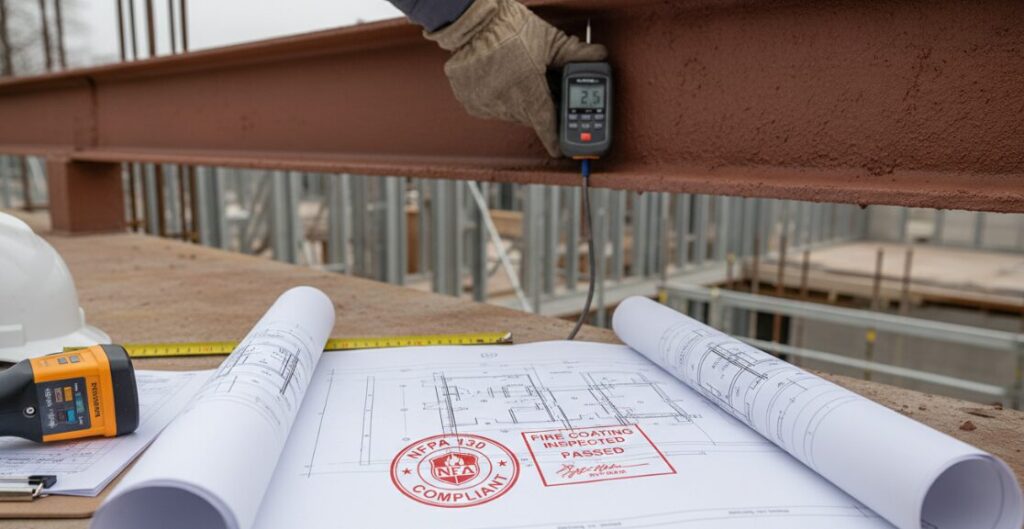
For any steel frame project, strict compliance with NFPA 220 (Standards for Types of Building Structures) is the bottom line. Steel structures are usually classified as Class I or Class II buildings. To maintain these classification levels, the passive fire prevention measures mentioned above are not optional, but mandatory. We must use design methods to match the “non-combustible” characteristics of steel with the “fire-resistant” design of the entire building.
Author: Robert Harrison
I am a structural engineer specializing in fire safety and high-performance building materials. With over a decade of experience in steel construction, I focus on helping building professionals navigate the complex relationship between material properties and NFPA safety compliance.
Related recommendations
-

Why Is Steel Used To Make Bridges
53Discover Why Steel Is The Backbone Of Modern Bridge Engineering. Learn How Its High Strength, Ductility, And Structural Flexibility Ensure Long-Lasting, Safe, And Efficient Infrastructure.
View details -
Do Steel Frame Homes Rust
203Modern Steel Frames Are Rust-Proof For 50-100 Years. Learn How Advanced Coatings Protect Your Home In Any Climate.
View details -
How To Clad A Steel Frame Building
158Master How To Clad A Steel Frame Building With Our Guide On Membranes, Panel Installation, And Weatherproofing.
View details -
What Are The Advantages And Disadvantages Of Steel Structures
23Discover The Pros, Cons, And ROI Of Steel Structures For Large Projects. Learn Key Fire And Corrosion Safety Solutions.
View details



HelloPlease log in