 GAOERJI STEEL


Search
How To Stop Condensation In A Steel Building
In order to effectively solve the problem of condensation water in existing steel structure buildings, the contact between the cold metal plate and the warm and humid air in the room must be cut off.
The most thorough and lifelong plan is to transform the structure and directly spray closed-cell polyurethane foam on the inside of the roof and walls. The thickness should be at least 1 to 2 inches (about 2.5-5cm), which can form a seamless thermal block and the strongest moisture barrier.
Of course, if your budget does not allow full spraying for the time being, you must implement a combination of “control and ventilation”: install super-large air volume and low speed (HVLS) fans to disperse the dead air, seal the exposed ground surface with heavy moisture-proof film to block the underground moisture, and be sure to install ridge ventilators to discharge the moisture.
The combination of thermal insulation and humidity control is the only way to prevent the metal surface from reaching the dew point.
Understanding The Dew Point In Metal Structures
To solve the problem of condensation, we have to talk about some common sense of physics, that is, the “dew point” mentioned above “.

Steel plates conduct heat very fast. As soon as the weather is cold, the low temperature outside will quickly conduct into the steel plate, causing its surface temperature to plummet. When the warm and humid air in the room comes into contact with this cold surface, the water vapor in the air cannot be hung up and is directly released in liquid form-this is condensed water.
All the methods we will talk about later have only one purpose: either to prevent the temperature of the inner metal surface from falling to the “dew point” where water will form, or to remove the water vapor before it has a chance to condense.
One-Step Solution: Closed-Cell Spray Foam
The most effective way is to create a seamless thermal resistance fault. In the renovation of steel structure buildings, closed-cell spray foam is far better than glass fiber cotton (fiberglass batt) for two main reasons:
- Form a moisture barrier: Unlike open-cell foam, closed-cell spray foam is dense and hard. As long as the spray thickness reaches 1-2 inches, it will not penetrate water. This is equivalent to directly blocking the hot and humid air out of the door, so that it has no chance to touch the cold metal roof or wall.
- Eliminate temperature difference: The foam is sprayed directly on the roof and inside the wall, which can absorb the heat in the room and keep the surface temperature above the dew point. Moreover, because the foam adheres tightly to the corrugations of the steel plate, it eliminates air gaps-which, in previous constructions, were often hidden spots for dirt and rust.
Although this is indeed a small investment, it is a “one-time construction, lifelong benefit” solution, because it solves the problem from the root: cutting off the “interaction” of hot air and cold metal “.
A Budget-Friendly Alternative: The “Control Plus Ventilation” Strategy
If a complete renovation of the insulation is not currently financially feasible, you have to manage the environment inside the building to mitigate condensation. The focus of this strategy is to reduce the humidity and keep the air flowing so that water vapor does not stay on the steel plate.
Use HVLS Fan To Disperse Stagnant Air
Air circulation is the enemy of dry steel structure building. Hot air naturally goes up and tends to accumulate in the ceiling slot (which is also the hottest part of the building), clinging to the cold roof (the coldest part of the building). This is where condensation begins to form.
It is important to install ultra-high volume low speed (HVLS) fans. These fans are not only to cool down, but also to do subtraction of air “stratification. By continuously mixing the upper and lower air, they can balance the temperature of the entire plant and prevent the humid and hot air from staying on the cold steel plate for a long time.
Use The Ground Moisture Barrier To Block The Rising Moisture
If moisture keeps coming out of the ground, it’s no use how much you can control it. In buildings where there is no moisture-proof cushion directly under the ground or concrete, underground moisture is the culprit that causes the indoor humidity to soar.
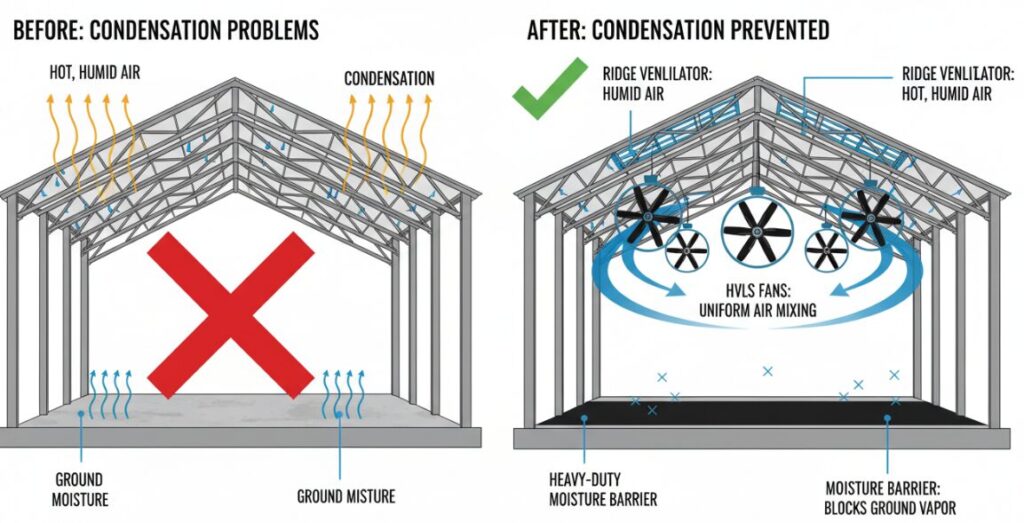
To solve this problem, you must seal the ground. A heavy duty moisture barrier, typically a very thick polyethylene sheet, is used to establish the physical barrier. This prevents underground moisture from evaporating into the air circulation within the building, thereby reducing the overall relative humidity and making the dew point harder to reach.
Exhaust Hot And Humid Air Through The Ridge Ventilator
Even if there is a fan stirring the air, the moisture has to have an outlet. Warm, moist air rises to the highest point of the steel structure. If there is no exit, they will accumulate at the ridge.
The installation of ridge ventilators can provide a passive exhaust system. When the fan pushes the airflow, the ridge ventilator allows the hottest and wettest air to naturally exit the building shell. This continuous air exchange ensures that the internal humidity is maintained at a controlled level and also reduces the stress on your ventilation strategy.
Frequently Asked Questions (FAQ)
Here are some common questions about moisture resistance in steel buildings, based on the most effective insulation and ventilation strategies:
A: The most comprehensive and permanent solution is to renovate the building and spray closed-cell polyurethane foam insulation. Spray at least 1-2 inches directly on the inside of the roof and walls, which can form a seamless thermal block to eliminate temperature differences, and at the same time act as a strong moisture barrier.
A: If spraying foam is over budget, you should adopt a “control plus ventilation” strategy. This includes the 3 steps of: 1) installing HVLS fans to disperse stagnant air; 2) laying heavy-duty moisture-proof membrane on exposed ground to block rising moisture; and 3) installing ridge ventilators to allow hot and humid air to exhaust outdoors.
A: In order to effectively prevent condensation, the minimum thickness of closed-cell spray foam should be 1 to 2 inches. This thickness is sufficient to produce the necessary thermal blocking effect and provide a strong moisture barrier to prevent hot air from contacting cold metal.
A: Underground moisture will significantly increase the indoor humidity, thereby raising the “dew point” temperature. If your building is bare ground, moisture will evaporate and rise and condense on the cold steel roof. Sealing the ground with a heavy-duty moisture-proof membrane is the key to cutting off this 1 source of humidity.
A: Yes. Ultra High Volume Low Speed (HVLS) fans are very effective because they eliminate air stratification. They mix the air layer and prevent the hot and humid air from stagnating near the cold metal surface, thereby reducing the possibility of condensation formation.
Author: Mark Davidson
“With over 17 years of experience in the metal construction industry, I specialize in building envelope performance. My focus is on helping steel building owners prolong the lifespan of their structures through proper thermal breaks, specifically closed-cell spray foam applications, and effective ventilation strategies. I believe that mastering the ‘dew point’ is the key to a durable, rust-free building.”