
 GAOERJI STEEL


Search
How To Design Bracing For Steel Structures
The core of the supporting design is to construct a clear force transmission path. To transmit wind load or seismic force to the foundation stably, you have to choose the right system: to have high rigidity, use central support (CBF); To be seismic and energy-consuming, use eccentric support (EBF). In the design process, the section selection usually falls on the HSS square tube or double angle steel, the purpose is very clear-to carry the axial tension and pressure. There is a snag here, that is, the slenderness ratio (KL/r) must be stuck in strict accordance with AISC 360 specifications, which is the “bottom line” to prevent the overall instability of the rod “. In addition, the node design can not tolerate careless, with the “force method” to fix the node plate, not only to meet the AISC 341 seismic ductility requirements, but also to consider the site installation space. Below I will take these key points apart and talk about them. They are all the places where problems are most likely to occur during drawing review.
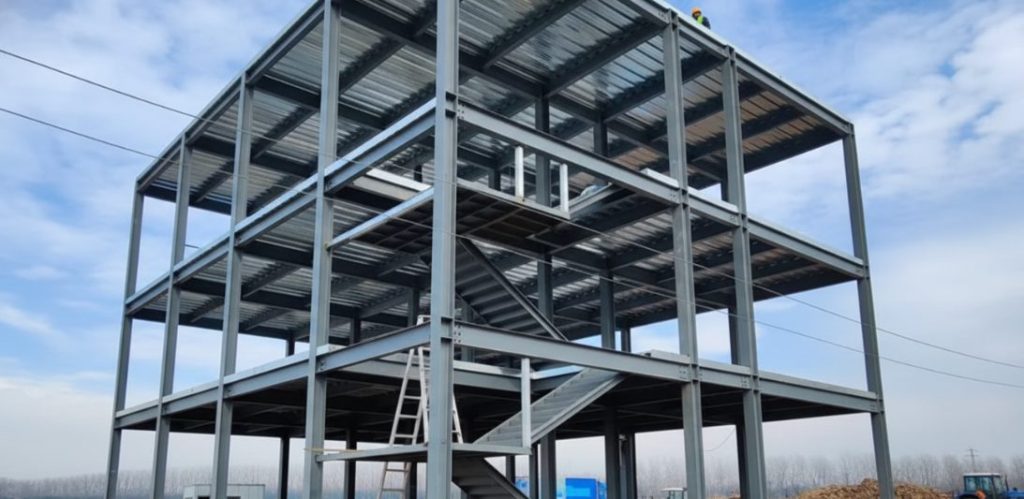
Clear Lateral Force Transmission Path
The essence of the bracing system is to cope with lateral loads. This requires that the entire path must be “closed” and smooth from the exterior wall, floor partitions, vertical supports, all the way to the foundation. Many times there are structural problems, not because the strength of the rods is not enough, but because the force transmission path is “cut off” at a certain node, or the force transmission logic is not clear. It must be ensured that each level of components can safely transfer the load to the next level.
System Selection: CBF vs. EBF
System selection is the first step to support the design. Center Support (CBF): The center line of the member meets at a node. This approach has a large stiffness and is useful for controlling interstory displacement under wind load, but the ductility performance is relatively general. Eccentric Support (EBF): By artificially creating an “eccentricity”, an “energy consuming beam section” is left on the beam. When an earthquake occurs, this beam section is used to yield and deform, absorbing energy like a shock absorber. In projects with high seismic fortification intensity, EBF is indeed more reliable than CBF.
Steel Structure Workshop
Steel Structure Workshops offer versatile designs. Clear Span ensures unobstructed space, while Centre and Intermediate Columns provide economical solutions for wide spans.
Bridge/Steel Structure Bridgeipsum
Steel Structure Bridges utilize high strength-to-weight ratios to achieve long spans where intermediate supports are difficult.Their versatility makes them essential for critical infrastructure connectivity.
Steel Structure Buildings
Steel Structure Buildings feature versatile designs to meet diverse needs. Clear Span offers open space, while Centre and Intermediate Columns increase economy for large spans. Multi Gable accommodates complex widths.
Selection Of Axially Stressed Components
The support is essentially a vertical truss. The components mainly bear axial force, and the selection is as follows: HSS: This is my first choice. Good cross-sectional characteristics, multi-axial compression, anti-instability ability is very strong. Double angle steel: that is, we often say “double angle steel”. The biggest advantage is good economy, convenient connection of node plates, and high cost performance in some conventional projects.
Strict Control Of Slenderness Ratio (KL/r)
What do compressive members fear most? Is buckling. The rod is under pressure, it wants to “drum” outward. At this time, the slenderness ratio is a hard indicator. When I checked the AISC 360 specification, staring at the KL/r limit was the basic skill. When calculating, the effective length coefficient (K), the support length (L) and the radius of gyration (r) can not be wrong, as long as the geometric size is controlled in this range, the component will not occur premature brittle instability.
The Average Force Method (UFM) Node Design
No matter how strong the support is, the node pulling the crotch will have to be finished. I suggest that you use the “mean force method” to deal with the node board. This method can scientifically balance the internal force of the beam, column and support at the node, avoid unnecessary yield of the node plate, and will not introduce additional bending moment to the beam-column member. This is not only a mathematical balance, but also an engineering insurance.
Seismic Ductility And Constructability Of Site Installation
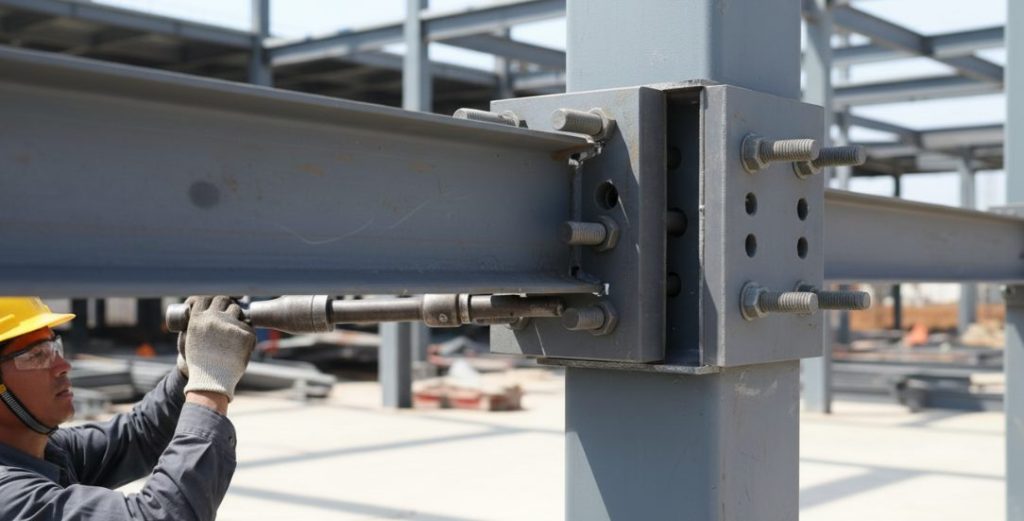
Seismic design can not only focus on the “strength”, but also look at the “ductility”. In particular, it is necessary to strictly follow the provisions of AISC 341 to ensure that the nodes can remain intact under large earthquakes and allow the components to be plastically deformed in the predetermined area. When designing nodes, be sure to leave enough operating space for on-site workers. Whether it is high-strength bolt locking or on-site welding, if the wrench cannot be extended and the welding torch is not close, then the design will have to be reworked even if it is exquisite. Always remember that good joint design is a balance of strength, stiffness and “good fitting.”
Author: Alex Sterling
I am a Senior Structural Engineer with over 10 years of experience in high-rise and industrial steel construction. Throughout my career, I have specialized in seismic design and the complex interaction of lateral force-resisting systems. My passion lies in bridging the gap between theoretical structural analysis and practical, site-ready execution.
The prev: What Type Of Steel Is Used In BridgesThe next: What Type Of Steel Is Structural Steel
Related recommendations
-

How To Build A Steel Frame Garage
182Master How To Build A Steel Frame Garage With This Precise 5-Step Protocol. Covers Plans, Concrete Slabs, Framing, And Insulation.
View details -
What Is The Main Advantage Of Structural Steel
186Discover Why Structural Steel’S Strength-To-Weight Ratio And Ductility Are Key To Engineering Efficiency And Safety.
View details -
How Structural Steel Is Made
22Explore The 5 Stages Of Structural Steel Production, From Raw Materials To Hot Rolling, In This Professional Guide.
View details -
What Foundations Are Used For Steel Framed Buildings
253What Foundations Are Used For Steel Framed Buildings? Discover The 4 Main Types: Floating Slab, Pads, Strip, And Piles.
View details


HelloPlease log in