
 GAOERJI STEEL


Search
How To Clad A Steel Frame Building
To make cladding for steel structure buildings is a systematic process of “stacking Buff. You have to make sure that the main frame is horizontal and vertical, and then lay a high-quality breathable film directly on the secondary component, which is the key to preventing condensation and solving the thermal bridge effect. Then, according to the design spacing of the wall beam or purlin fixed, to provide sufficient support for the outer skin. When installing the enclosure board-whether it is a single-layer board or a sandwich composite board, it must be installed from the corner of the leeward side to the windward side, and the board must overlap at least one complete wave crest, so as to save rain from seeping in the future. The screws should be self-drilling screws with EPDM rubber gaskets. The wall panel should be hit on the “wave trough” and the roof panel should be hit on the “wave crest”, so that the seal is stable. Finally, seal the dripping eaves, yin and yang corners and roof ridges with precisely cut watering pieces , and line the inside with butyl adhesive tape, so that your workshop or warehouse can be truly watertight for decades.
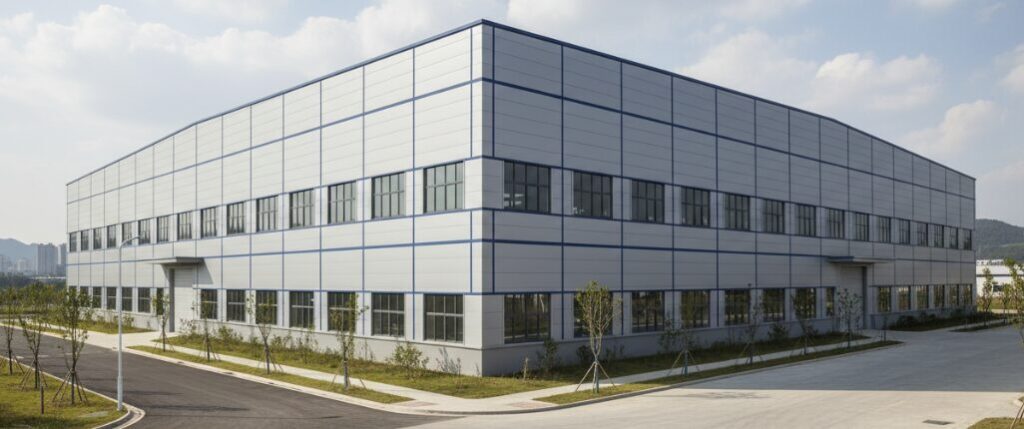
Phase 1: Frame Calibration And Moisture Management
Before hanging any boards, you have to review the stability of the main structure. If the main component is crooked even a little bit, the rear maintenance board will not be aligned at all, which is not only ugly, but also leaves a hidden danger of water leakage. After the frame is straightened, the next step is to lay the breathing paper. This layer of film is directly pulled on the secondary component, mainly in charge of two things:
- Condensation control: It allows moisture to drain from the house while keeping out rain from outside.
- Alleviate the thermal bridge effect: This layer plays a role of physical isolation, reducing the conduction of outdoor cold air to the internal steel structure, preventing the house from “sweating” in winter, and saving a lot of air conditioning costs.
Phase 2: Installation Of Secondary Members
In order to carry the plate weight and wind load, you have to install a sub-component system. Usually the wall is called girder and the roof is called purlin. These members must be fixed in strict accordance with the spacing given on the engineering drawings. They are like the “skeleton” of the outer skin, which is the only place where the self-drilling screw can bite. If the spacing is left too casually, the plate will shake or even make a noise on a windy day.
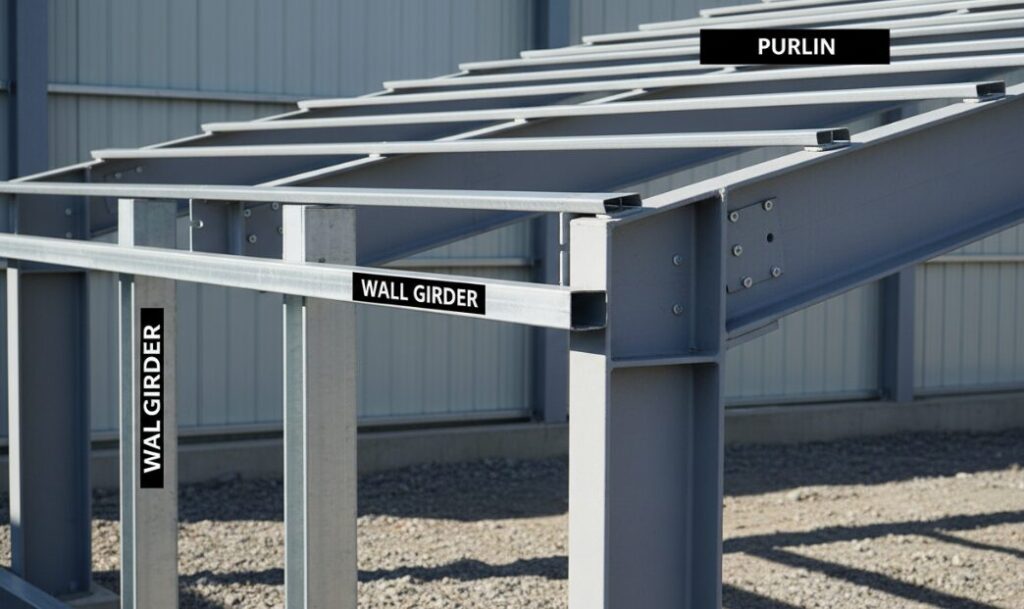
Phase 3: Positioning And Laying Of The Enclosure Board
Whether you choose a cost-effective single-layer board or a sandwich composite board with full performance, the installation logic is universal:
- Keep an eye on the wind: always shop from the leeward side. In this way, the joint of the board is just facing away from the wind, so that rainwater will not be “poured” into the house by the strong wind along the gap in rainy days.
- Lap principle: in order to the most secure waterproof effect, at least to fold a complete wave crest. The physical barrier of this crest can effectively cut off capillary action and prevent water seepage in rainstorm days.
Steel Structure Workshop
Steel Structure Workshops offer versatile designs. Clear Span ensures unobstructed space, while Centre and Intermediate Columns provide economical solutions for wide spans.
Bridge/Steel Structure Bridgeipsum
Steel Structure Bridges utilize high strength-to-weight ratios to achieve long spans where intermediate supports are difficult.Their versatility makes them essential for critical infrastructure connectivity.
Steel Structure Buildings
Steel Structure Buildings feature versatile designs to meet diverse needs. Clear Span offers open space, while Centre and Intermediate Columns increase economy for large spans. Multi Gable accommodates complex widths.
Phase 4: Fastening Skills To Ensure Water Tightness
How many years a steel structure can last depends to a large extent on how the screws are screwed. Be sure to use self-drilling screws with EPDM (ethylene propylene diene monomer) washers. This rubber pad forms a permanent watertight seal compression. Here’s a technique that must be followed in the industry:
- Wall panel: the screw should be hit in the “wave trough” (close to the flat place of the purlin), so that the force is the most stable and the board is not easy to be lifted by the wind.
- ROOF PANELS: Screws must hit the “crest” (high out of the ridge). In this way, rainwater will flow along the slope instead of accumulating around the screw holes, minimizing the risk of water leakage.
Phase 5: Flashing Parts And The Final Waterproof Closure
The final level is to block the building’s “soft ribs”-corners, joints and edges. In order to make the project look professional, fine-cut flooding parts are essential:
- Drip Edges: Mounted at the foot of a wall to draw water away from the edge of the foundation.
- Corner Trims: Used to seal the vertical gap where two walls meet.
- Ridge Caps: Mounted at the top of the roof to cover the gap between the two sloping panels.
In order to ensure that there is no water leakage in this life, all floodwater parts should be lined with butyl tape or industrial grade sealant. This “double insurance” treatment can ensure that your workplace, farmhouse or garage will always be dry and dry for decades to come.
Author:Marcus Thorne
With over 14 years of experience in industrial steel construction, I specialize in building envelope solutions that prioritize durability and thermal efficiency. Having overseen dozens of workshop and barn projects, I believe that the secret to a long-lasting structure lies in the precision of the cladding process—from the initial vapor barrier to the final ridge cap.
Related recommendations
-

What Type Of Steel Is Used In Bridges
24Explore Bridge Steel Grades Like ASTM A709, A588, And HPS 70W. Learn Why Toughness And Dynamic Load Resistance Matter.
View details -
What Is The Maximum Carbon Content Of Structural Steel
15Learn Why Carbon Limits And Carbon Equivalent Are Vital For Modular Steel Weldability And Structural Safety.
View details -
Is Steel Structure Cheaper Than Concrete
25Save 30% On Labor And Finish Months Faster. Learn Why Steel Offers A Higher ROI Than Concrete For Your Next Project.
View details -
What Foundations Are Used For Steel Framed Buildings
253What Foundations Are Used For Steel Framed Buildings? Discover The 4 Main Types: Floating Slab, Pads, Strip, And Piles.
View details



HelloPlease log in