
 GAOERJI STEEL


Search
How To Build Steel Frame Building
Building a steel frame building is actually a comprehensive work of logistics scheduling and engineering technology. The entire cycle is usually between 3 and 6 months, from the design of the prefabricated metal building (PEMB) to the final cap cover. You have to get the local land planning approval before starting work, and take the project blueprint with the registration stamp to finalize the construction permit. At the scene of practical operation, the first is the site leveling and foundation construction, anchor bolts must be embedded extremely accurately, must be welded with the factory welded column foot bottom plate tightly; The second is the hoisting stage, that is, cranes or large-tonnage forklifts enter the site to assemble the main steel structure (steel columns and I-beams) into the main rigid frame. The third step is to install purlins, immediately after the spread of thermal insulation cotton and color steel plate. This is not the traditional “building a house”, but a high-precision assembled plate. Whether it will be postponed or not, whether it will exceed the budget or not depends on whether you have a good foundation and whether the on-site materials are arranged smoothly.
Pre-Construction: Design, Logistics And Construction Approval
Before the ground was broken, the progress of the project was actually stuck in the design process of prefabricated steel structures. Unlike cast-in-place concrete, steel structures are all processed in the factory according to the drawings one by one. This stage often takes a long period of time in the 3 to 6 month cycle. Sometimes the approval of drawings is slightly blocked, and the scene at the back has to be saved to push the progress. To get the project going, you need to sort out these hard and fast rules:
Land planning approval (Zoning Laws): Make sure that the building you want to build complies with local land use and planning regulations.
Stamped engineering blueprints: Without these, you simply cannot obtain a construction permit. These blueprints form the foundation of the entire project, calculating loads, stresses, and the specific geometric dimensions of the steel frame. On site, the drawings are law, and the absolute authority of the structure.
The First Stage: Site Leveling And The Absolute Accuracy Of The Foundation
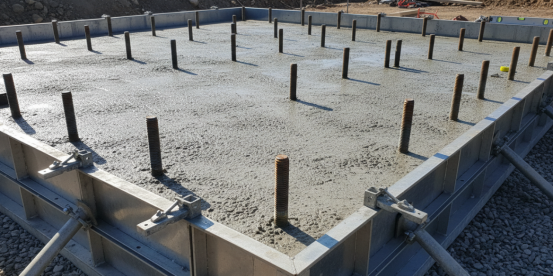
Whether the steel structure can work smoothly depends on the work of the foundation. This is the most critical link. If something goes wrong at this stage, the cost of rework will be staggering. Site leveling requires cleaning, leveling and compaction, and the foundation must be strengthened to withstand the heavy steel structure above. When the venue is ready, your eyes will have to be on the base plan. For dry steel structures, errors are not allowed, and the tolerance for concrete foundation pouring is extremely small. The most important thing here is to embed anchor bolts-these anchor bolts must be perfectly aligned with the reserved holes in the steel column bottom plate. Let’s put it this way, as long as the anchor bolt is off even a few millimeters, the steel column perforated by the factory will not fall down at all. Before, I have met inexperienced teams and groups who suffer from this. Therefore, before concrete is hit, the positioning template must be used for repeated proofreading, and the concrete must be checked one times with instruments before solidification.
The Second Stage: Hoisting Stage (Main Steel Structure)
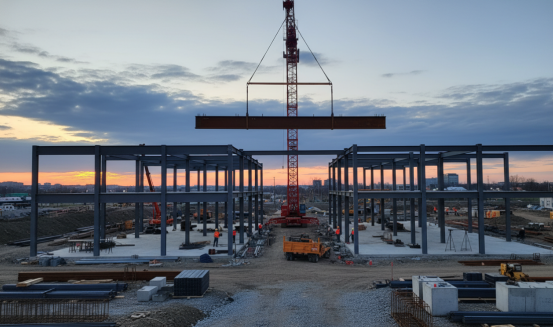
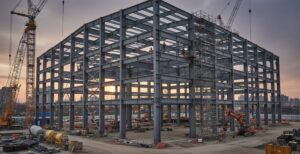
When the foundation concrete is cured to strength, it is time to enter the “hoisting” stage. At this time is to build the main skeleton, we often say the main steel structure. Heavy machinery must enter the site, depending on the span size, forklift or truck crane must be arranged on site to lift the dead steel column and I-beam in place.
Steel column: directly hoisted, aligned with the anchor bolts into the fall.
Roof beam/I-beam: hoisted to mid-air and butt-jointed with steel column.
Bolt fastening: all these large parts are fastened with high-strength bolts to form a stable main rigid frame. There is an on-site skill-it depends on the “site layout” of the materials. You have to arrange the components on the ground in advance according to the lifting sequence, and don’t wait for the crane hook to come down and then rummage through the pile of iron, which is too long for the lifting shift.
Steel Structure Workshop
Steel Structure Workshops offer versatile designs. Clear Span ensures unobstructed space, while Centre and Intermediate Columns provide economical solutions for wide spans.
Bridge/Steel Structure Bridgeipsum
Steel Structure Bridges utilize high strength-to-weight ratios to achieve long spans where intermediate supports are difficult.Their versatility makes them essential for critical infrastructure connectivity.
Steel Structure Buildings
Steel Structure Buildings feature versatile designs to meet diverse needs. Clear Span offers open space, while Centre and Intermediate Columns increase economy for large spans. Multi Gable accommodates complex widths.
The Third Stage: Secondary Structure Installation And Edge Sealing
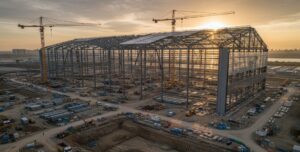
Once the main rigid frame is erected and corrected, the skeleton is finally filled in and the house is sealed.
Substructure: This is mainly the installation of roof purlins (across the roof beam) and wall beams (along the wall horizontal walk). These lightweight components are used to provide fixed support for the rear outer maintenance plate. Sometimes the wind is strong on site, and the secondary structure must be tightened with bolts, otherwise it is easy to shake.
Insulation cotton and color steel tile: the secondary structure is fixed, followed by laying insulation cotton (some are coiled material laying, some are sprayed), and then immediately fix the metal pressure plate (color steel tile) with self-tapping nails.
Author: Michael Turner
I am a Senior Structural Project Manager with over 13 years of experience in Pre-engineered Metal Building (PEMB) systems. Specializing in heavy industrial projects, I focus on the precise orchestration of logistics and red iron steel assembly.
The prev: Is Steel Frame Non CombustibleThe next: Why Is Steel Used To Make Bridges
Related recommendations
-

How To Design Bracing For Steel Structures
19How To Design Bracing For Steel Structures
View details -
Do Steel Buildings Need A Foundation
209Yes, Permanent Steel Buildings Need A Foundation To Prevent Wind Uplift And Settling. Learn About Cost-Effective Alternatives To Full Slabs, Like Piers.
View details -
Is Steel Frame Non Combustible
88Is Steel Non-Combustible? Learn Why Steel Frames Need Protection To Maintain Structural Integrity During Fire Events.
View details -
What Are The Advantages And Disadvantages Of Steel Structures
21Discover The Pros, Cons, And ROI Of Steel Structures For Large Projects. Learn Key Fire And Corrosion Safety Solutions.
View details

HelloPlease log in