
 GAOERJI STEEL


Search
How To Build A Steel Frame Garage
To successfully build a steel structure garage, first, you need to get special engineering drawings and permits according to the local wind load and snow load; Second, pour the integral concrete slab with reinforcing ribs and embedded anchor bolts-this step must be accurate, because steel does not tolerate uneven ground like wood. Third, build the main frame by fixing columns and hoisting pre-assembled trusses. Fourth, install secondary structures (wall and roof purlins) to stabilize the overall structure; finally, do a good job of insulation, put on metal plates and edge pieces to ensure that water does not leak.
Step 1: Planning And Approval
Before the ground was broken, the entire construction process actually began with engineering design and legal compliance.
To make a wooden garage, you may be able to find a general blueprint, but a steel garage is not. What you need is a drawing calculated by a structural engineer. These drawings are “tailor-made” for prefabricated steel components produced by specific manufacturers, and it will tell you in detail how to assemble each part.
The most critical point is that these drawings must be adjusted for the specific wind and snow loads of your location. Steel structure is a tight engineering system; your snowy garage in Minnesota has a completely different structural algorithm than your hurricane-resistant garage in Florida, so don’t mix it up. Once you get these site-specific engineering drawings, you’ll have to submit them to your local municipality for a building permit. Don’t save this step, and don’t think about going around, because the zoning law and the red line requirement will directly determine how big and where your garage can be built.
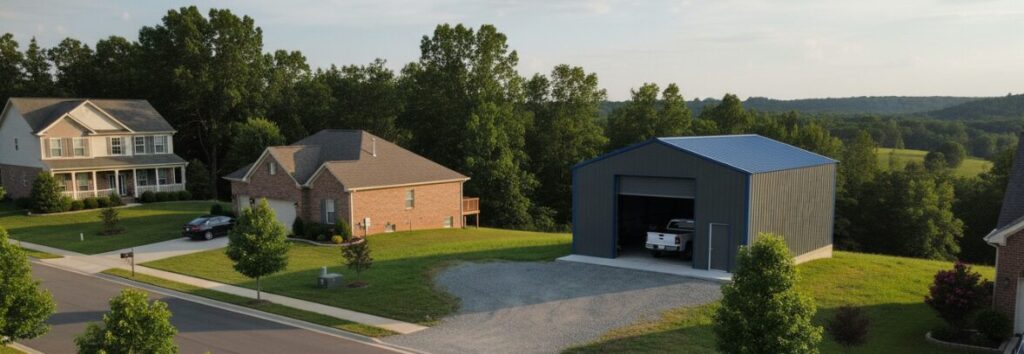
Step 2: Pouring Foundation
You must pour a whole concrete slab, that is, the ground and foundation (or load-bearing thickened belt/Haunch) are continuously poured in one operation. The perimeter of the slab-that is, the load-bearing belt-must be thickened and reinforced, after all, it has to carry the huge concentrated load passed down by the steel columns.
At this stage, the detail I must emphasize repeatedly is the positioning of the anchor bolts. Steel columns need to be bolted directly into the wet concrete. You must follow the engineering drawings and use templates to accurately position these bolts. Here, accuracy is life: the board must be absolutely square and level. Even if the bolt is only a fraction of an inch off, the steel column that has been punched in advance will not match. If you want to repair it then, the price will be too high to give you a headache.
Step 3: Build The Main Framework
Once the concrete curing is completed, we will start the vertical construction and build the main frame. This usually includes a garage “skeleton” made up of I-beam columns and rafters “.
- Fix the column: Hoist the steel column to the anchor bolt. First, loosely fix it with a nut, leaving some margin to facilitate fine adjustment of verticality.
- Assembling trusses: Arrange for the roof rafters (trusses) to be assembled on the ground at the same time as the columns. Believe me, working on the ground is much safer and more efficient than fighting those heavy beams in mid-air.
- Lifting and locking: use forklift or crane to lift the assembled truss and bolt it to the top of the column. At this time, you must also install the X-support (usually a steel cable or tie rod). These supports straighten the house and prevent the frame from twisting or shaking before the rest of the installation.
Steel Structure Workshop
Steel Structure Workshops offer versatile designs. Clear Span ensures unobstructed space, while Centre and Intermediate Columns provide economical solutions for wide spans.
Bridge/Steel Structure Bridgeipsum
Steel Structure Bridges utilize high strength-to-weight ratios to achieve long spans where intermediate supports are difficult.Their versatility makes them essential for critical infrastructure connectivity.
Steel Structure Buildings
Steel Structure Buildings feature versatile designs to meet diverse needs. Clear Span offers open space, while Centre and Intermediate Columns increase economy for large spans. Multi Gable accommodates complex widths.
Step 4: Installation Of Secondary Structures
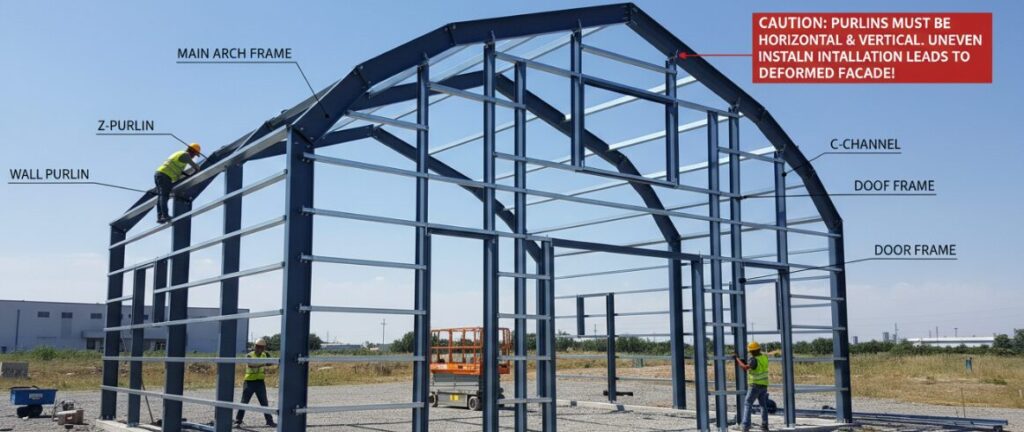
After the main arch is in place, the next step is to install the secondary structure. This step is to grid the wall panels and roof panels. This mainly includes wall purlins and roof purlins.
Usually we use Z-purlins and C- channel steel, which are bolted to the connecting clips on the main posts and rafters. They provide lateral stability to the main frame. At the same time, this is also the time to make door and window frames (using door frames and lintel) for rolling shutters, single doors and windows.
- There is a pit here to note: the secondary structure must be horizontal and vertical. Because these members directly provide the attachment surface for the metal outer plate. If the wall purlin has waves or bends, when the outer plate is installed, the outer facade can clearly see unevenness and is very ugly.
Step 5: Sealing Plate, Heat Preservation And Edge Closing
The final phase focuses on the building envelope-the garage must be weatherproof and insulated.
- Insulation: Before laying the metal plate, the insulation cotton (usually a glass fiber blanket with a moisture-proof layer) is suspended and laid on the roof and wall purlin. This helps prevent condensation problems-what we often call “sweating” in metal buildings “.
- Metal plate installation: Use self-tapping screws with neoprene gaskets to install wall and roof panels. These gaskets form a waterproof seal around each screw hole. Remember to strictly follow the screw arrangement mode specified by the manufacturer, otherwise the wind resistance level may not be met.
- Edge closing and waterproofing: Finally, install corner, eaves and ridge edge closing pieces to finish. In the roof and the bottom of the stuffed foam blocking strip, and with high quality sealant, do not let pests and moisture get in.
Author:Marcus Thorne
I’m a veteran construction manager with over 14 years of experience specializing in pre-engineered metal buildings. Having overseen the erection of hundreds of residential and commercial steel structures, I focus on helping builders navigate the complexities of concrete foundations and heavy-gauge framing.
