
 GAOERJI STEEL


Search
How To Anchor Steel Building To Ground
The most effective way to anchor a steel structure to the ground depends entirely on the type of foundation you choose.
If you are facing a concrete floor, you must use heavy expansion bolts or wedge anchors (usually 1/2 inch in diameter), through the base rail and embedded at least 4 to 5 inches deep, so as to resist the pulling force generated by the updraft. If the foundation is raw soil, mud or gravel, it is necessary to change the way of thinking and use high-torque spiral ground anchors (also known as “mobile board house ground anchors” in the industry), which must be at least 30 to 36 inches into the ground to ensure that the building does not undergo structural displacement under high wind loads.
If it is fixed on concrete, remember to drill an accurate guide hole with a percussion drill first, and then tighten the anchor bolt according to the torque standard required by the manufacturer. If it is directly driven into the ground, be sure to ensure that the screw anchor head is completely below the permafrost line, otherwise seasonal “frost heave” will give you a headache. Whether you want to build a backyard studio, tractor shed or large metal garage, these two options are the bottom line to ensure structural stability.
Method 1: Anchoring The Steel Structure On The Concrete Floor
When your steel building is on a concrete foundation, the goal is to establish a permanent rigid connection between the steel base rail and the floor to prevent lateral offset and wind-induced uplift.
This video shows how to anchor a metal building on a concrete slab:
Tools And Materials List
- Wedge Anchor: 1/2 inch in diameter (standard for most metal garages).
- Impact drill: used to deal with high strength concrete.
- Carbide stone drill bit: the diameter should match the anchor bolt.
- Torque wrench: Make sure the bolt tightness is in accordance with the manufacturer’s specifications.
- Industrial vacuum cleaner or compressed air: used to clean dust in the hole.
Installation Steps
- Positioning base rail: Ensure that the steel frame is completely square on the floor.
- Drill the pilot hole: take the pre-drilled hole on the base guide rail as the guide, and use the impact drill to drill the concrete. The depth must reach 4 to 5 inches so that the expansion mechanism has enough “grip” space.
- Cleaning the hole: This is a key technical point-the dust remaining in the hole will prevent the anchor bolt from being in place. Be sure to blow the debris clean with compressed air.
- Knock in the wedge anchor: Use a hammer to drive the anchor through the guide rail into the hole, leaving enough thread height to install the washer and nut.
- Apply torque: Tighten the nut. This pulls the wedge upward, holding it open and against the concrete hole wall, locking the entire structure.
Method 2: Anchoring Steel Structures Directly To Soil Or Gravel
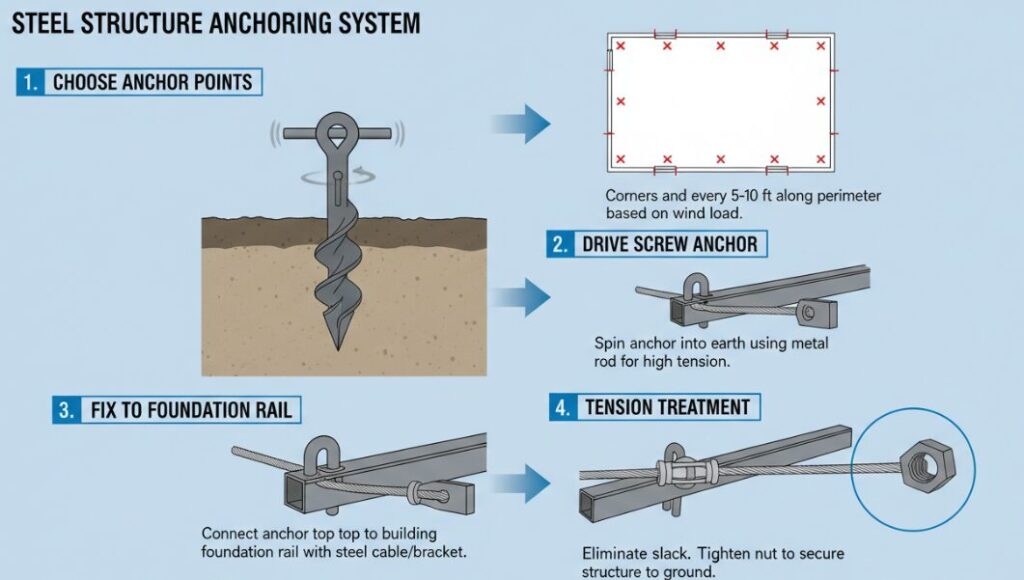
If you do not pour concrete floor, it can only rely on the depth of the earth and friction. In the industry, the use of high-torque screw ground anchors is standard practice for fixing simple houses or carports.
Importance Of Anchorage Depth And Frozen Soil Line
In order to prevent the building from “frost heave” (I. e., being jacked up during the freeze-thaw cycle), the screw head of the ground anchor must be driven 30 to 36 inches deep. This ensures that the anchor heads penetrate below the permafrost line, where the soil temperature and density are more stable and less affected by the climate.
Installation Steps Of Soil Anchor
- Choose anchor points: usually one at each corner of the building, and then arrange one every 5 to 10 feet along the perimeter, depending on your local wind load requirements.
- Drive screw anchor: Use a metal rod or power drive head to spin the screw anchor into the earth. This kind of “cork pull” design can be combined with the soil to produce extremely high tension.
- Fix to foundation rail: After the anchor head is completely submersed into the ground, connect the top of the anchor bolt to the building foundation rail with a heavy steel cable or bolt fixing bracket.
- Tension treatment: ensure that there is no slack at the connection. For “movable plank house” anchor bolts, tighten the integrated nut and drag the building to the ground.
Steel Structure Workshop
Steel Structure Workshops offer versatile designs. Clear Span ensures unobstructed space, while Centre and Intermediate Columns provide economical solutions for wide spans.
Bridge/Steel Structure Bridgeipsum
Steel Structure Bridges utilize high strength-to-weight ratios to achieve long spans where intermediate supports are difficult.Their versatility makes them essential for critical infrastructure connectivity.
Steel Structure Buildings
Steel Structure Buildings feature versatile designs to meet diverse needs. Clear Span offers open space, while Centre and Intermediate Columns increase economy for large spans. Multi Gable accommodates complex widths.
Structurally Robust Technical Specifications
Whether you build a studio or a tractor shed, the physics is the same. You are primarily fighting two forces:
- Uplift Forces: The wind blowing over the top of the building creates a vacuum-like suction. A 1/2 inch wedge anchor or a 36 inch helical ground anchor provides the necessary “down weight” to counteract this force.
- Shear Forces: Shear forces caused by side winds or structural displacement. Proper placement of anchor bolts can distribute this load evenly over the entire foundation.
Summary Comparison Table
| Feature | Concrete Foundation | Soil/Gravel Foundation |
| Anchor Type | 1/2-inch Wedge/Expansion Bolts | Spiral Auger / Mobile Home Anchors |
| Minimum Depth | 4 to 5 Inches | 30 to 36 Inches |
| Primary Tool | Hammer Drill | Manual Turning Bar or Power Drive |
| Key Risk | Inadequate Pilot Hole Cleaning | Frost Heaving (if above frost line) |
By following these specific anchoring procedures, you can ensure that your steel structure is not only safe and flat, but also meets the wind resistance requirements of most local building codes.
Author: Marcus Thorne
Hi, a structural specialist with over 10 years of experience in metal building assembly and site preparation. I have overseen the installation of everything from residential steel workshops to industrial-grade garages, focusing heavily on foundation integrity. I specialize in precision anchoring techniques—whether you’re drilling into reinforced concrete or securing augers into challenging soil—to ensure your building remains stable regardless of the environment.
