
 GAOERJI STEEL


Search
How Structural Steel Is Made
The production process of structural steel is extremely rigorous and is usually divided into four core stages: raw material preparation, ironmaking, steelmaking and finished product forming. Simply put, it’s either a “1 pot stew” of iron ore, coke and limestone into pig iron in a blast furnace, or a direct melting of recycled scrap steel in an electric arc furnace (EAF). The molten metal is then refined in a converter (BOF) until the carbon content and chemical composition are completely up to standard. The refined molten steel is continuously cast into billets or rectangular billets, which are finally hot rolled at a high temperature above 1700 °F (about 925°C) and pressed into the shape we need.
The First Stage: Raw Material Preparation
The basis of high-quality structural steel is the purity of the raw materials. According to the factory’s production route, there are usually two ways to do it:
Long process (iron ore route): This is a more traditional approach and requires iron ore, coke (extracted from coal) and limestone. Iron ore provides iron, coke is both fuel and reductant, and limestone is a “scavenger”, responsible for taking away impurities.
Short process (scrap recycling route): Today’s structural steel production is increasingly dependent on the scrap cycle. To be honest, this method is extremely efficient, and because the material has been refined 1 times before, the re-smelting speed is very fast and environmentally friendly.
The Second Stage: Ironmaking (Blast Furnace Stage)
In traditional established steel mills, these raw materials are fed into huge blast furnaces.
Smelting: blast furnace will blow into the high temperature hot air, so that coke burning, produce extreme high temperature.
Reduction: This chemical reaction removes the oxygen from the iron ore, leaving the liquid “pig iron”.
Slagging: Limestone combines with impurities such as silicon to form slag, which floats on top of molten iron like oil flowers and is then cleaned up.
According to my experience, the carbon content of pig iron at this stage is as high as 3-4%, which is as crisp as biscuits. You absolutely dare not use it to build a building structure. You must further reduce carbon.
Steel Structure Workshop
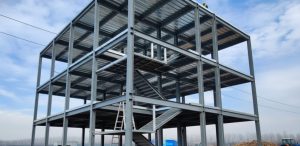
Steel Structure Workshops offer versatile designs. Clear Span ensures unobstructed space, while Centre and Intermediate Columns provide economical solutions for wide spans.
Bridge/Steel Structure Bridgeipsum
Steel Structure Bridges utilize high strength-to-weight ratios to achieve long spans where intermediate supports are difficult.Their versatility makes them essential for critical infrastructure connectivity.
Steel Structure Buildings
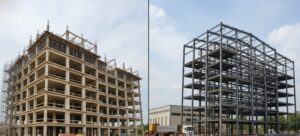
Steel Structure Buildings feature versatile designs to meet diverse needs. Clear Span offers open space, while Centre and Intermediate Columns increase economy for large spans. Multi Gable accommodates complex widths.
The Third Stage: Steelmaking And Refining
To turn pig iron or scrap steel into “structural grade” steel, the core task is to precisely control the carbon content and add alloying elements.
Converter (BOF): Blowing high-purity oxygen into molten pig iron to oxidize excess carbon and impurities.
Electric Arc Furnace (EAF): Uses a powerful electric arc to melt 100 percent of scrap steel. I personally prefer this process because it is very precise and flexible in controlling the chemical composition.
Secondary metallurgy: After the basic molten steel comes out, it is usually subjected to vacuum degassing or ladle refining. If you want to make steel more resistant to corrosion or mechanical properties, manganese or silicon these alloying elements are added at this time.
The Fourth Stage: Continuous Casting
After the composition of the molten steel is perfectly formulated, it must be solidified and formed. Modern steel mills have long stopped using the old-fashioned die casting method, which is basically continuous casting.
The molten steel is poured into the tundish, then flows into the water-cooled crystallizer, and when it comes out, it becomes long billets, billets or slabs. The biggest advantage of continuous casting is to ensure that the internal organization of the steel is uniform, and the waste is minimal, which provides a very stable “blank” for the final rolling.
The Fifth Stage: Forming And Hot Rolling
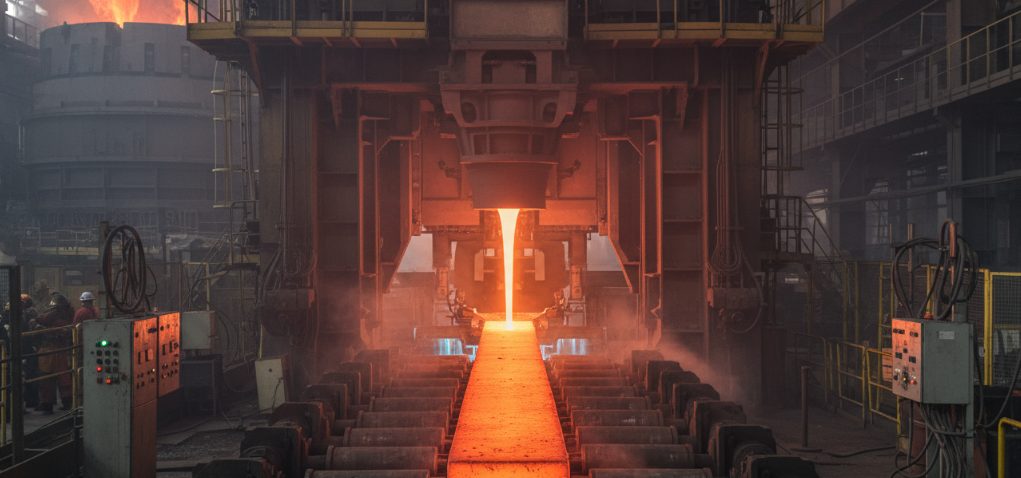
This is the most critical step in defining the “structure” attribute, and it is also the most spectacular scene.
Reheating: The billet is fed into the furnace and the temperature is raised again above 1700 °F. At this point the steel is as malleable as plasticine, but not yet to the point of melting.
Rolling: The red-through billet passes through a series of heavy-duty mills. Every time, the shape changes a little.
Section forming: special rolls will exert great pressure to press the steel into I-beam, H-beam, channel steel or angle steel.
Metallographic organization improvement: This extremely strong mechanical pressure is not only changing the shape, it is also crushing and refining the internal grain structure. It is this microscopic change that gives structural steel its amazing tensile strength and toughness.
Why Are Manufacturing Processes Critical To Building Quality?
Knowing how structural steel is made, you will understand why it is irreplaceable in the field of infrastructure. From the control of chemical composition in the converter to the physical deformation on the hot rolling mill, every link is to ensure the “predictability” of performance. Whether it is ordinary I-beam or the support of cross-sea bridge, the metallurgical logic behind it is to ensure that it will not move in the face of super-strong loads.
Author: Robert Chen
I have spent over a decade ‘groping’ my way through the steel structure industry, working hands-on with the I-beams and H-beams that form the backbone of our modern cities. My career has been defined by a fascination with how raw ore and recycled scrap are transformed into high-strength structural skeletons. I’ve spent countless hours in steel mills, observing the precision of electric arc furnaces and the power of hot rolling mills.
Related recommendations
-

How To Install A Vinyl Window In A Steel Building
188Step-By-Step Guide On How To Install A Vinyl Window In A Steel Building. Use The Wood Buck System For A Structural Seal.
View details -
How To Build Steel Frame Building
83Master How To Build Steel Frame Building. From Foundation Precision To Red Iron Erection, Follow Our Expert 3-Phase Guide.
View details -
How Long Does It Take To Build A Prefabricated Home
12Build Your Home In 12-24 Weeks! Learn How Our Prefab Process Saves 50% Of The Time Vs. Traditional Construction.
View details -
How To Design Bracing For Steel Structures
20How To Design Bracing For Steel Structures
View details

HelloPlease log in