 ACIER GAOERJI


Recherche
What Is Steel Fabrication? Top Fabricated Steel Uses
What exactly is steel fabrication? It is an industrial process that transforms raw alloy steel into ready‑to-install structural components through precise cutting, bending, assembly, and welding. So what is fabricated steel? It refers to the final, value-added product—such as custom‑made I‑beams, piping networks, or load‑bearing trusses specifically engineered for a particular construction or manufacturing project—each of which must meet precise structural and spatial requirements.
I’ve seen far too many project managers and procurement teams suffer in silence at this stage, with budgets routinely overspent by nearly 30%. The reason is that they simply haven’t grasped the intricacies of those key stages, from raw material procurement to final processing and product output. Next, let’s take the entire process of steel processing apart and uncover the cost drivers that are really eating up your budget, and by the way, see which industrial application scenarios directly determine the success or failure of your project.
The Difference Between Raw Steel And Processed Products
Engineers and purchasers must distinguish between raw steel , which is related to whether your project budget can be accurate. If you think about it, the raw steel pulled out by the steel mill is in the standard bulk form: flat plate, hollow profile, steel coil, or standard I-beam. And processed steel? It’s a custom product of machining and joining these original parts according to the exact architectural blueprint.
Buying raw steel is like buying freshly cut, untreated wood. When you buy processed steel, you buy a roof truss that has been customized, load tested, and ready to be lifted by a crane.
A piece of virgin structural carbon steel, it has only potential tensile strength. However, a piece of processed steel has been cut to a millimeter tolerance and welded with certified penetration technology. The surface is also coated with anti-corrosion zinc primer in order to withstand the erosion of a specific external environment. The engineering precision invested in the entire transformation process is its real value.
| Fonctionnalité | Raw Steel | Fabricated Steel |
| Sourcing | Directly from steel mills or suppliers | From raw steel suppliers, then processed by fabricators |
| Shape | Standard forms: beams, sheets, bars, coils | Custom shapes, sizes, and assemblies |
| Cost Structure | Primarily material cost, quantity-dependent | Material cost + labor, machinery, and design costs |
| Ready for Installation? | No, requires further processing and shaping | Yes, pre-cut, pre-drilled, pre-welded for assembly |
| Examples | Steel plates, I-beams, rebar, steel coils | Building frames, bridge components, car chassis, machinery parts |
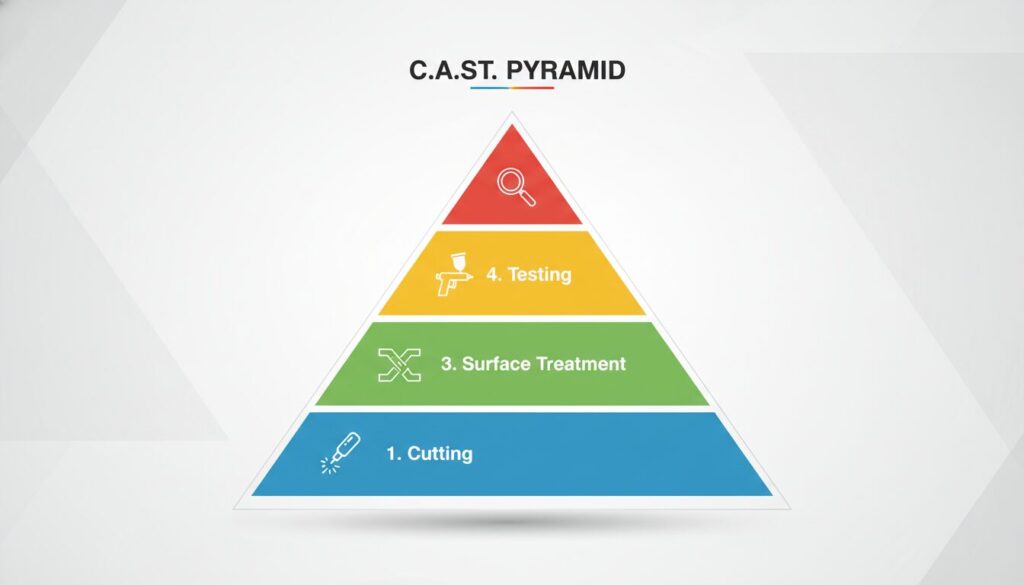
The C.A.S.T. Model: Four Stages Of Steel Processing
To control the whole processing process, you have to have a structured idea. In the past ten years of staring at the landing of various commercial steel contracts, I have summarized a set of C.A.S.T. models. Take this framework to provide junior civil engineers and B2B procurement seams, which can help them see through what is happening in the workshop at a glance.
C – Cutting and Profiling
In today’s commercial projects, the processing plant has long stopped cutting structural steel by hand. High-precision CNC (numerical control) plasma cutting machine, fiber laser machine and water jet basically take over the initial forming work. This step is the dimensional accuracy. If the cutting stage is 2mm off, when the site is hoisted, the error will accumulate to be a disaster-level dislocation.
A – Assembling and Bending
Workers will first use a bending machine to press the steel plate into the required angle, and then splice. The assembly of this piece relies heavily on certified welders to weld the cut parts together with MIG, TIG or manual arc welding. The biggest pit here is thermal deformation. Sophisticated processing plants will skillfully arrange the welding sequence to prevent the steel from warping under extreme thermal stress.
S-Surface Treatment
Exposed steel wastes quickly. The processing plant will use steel shot to blast the assembled parts to remove the scale and rust . Immediately afterwards, they will quickly paste a protective layer, such as hot-dip galvanized or intumescent fire-retardant paint. To put it bluntly, how long the processed steel can live in bad weather depends on the surface treatment of this layer.
T-Testing and Quality Assurance
For load-bearing structures, it is absolutely impossible to look at them with eyes alone. Quality inspection engineers have to use non-destructive testing, especially ultrasonic testing and magnetic particle inspection, to find out the microscopic cracks in the weld that are invisible to the naked eye.
Top Application Scenarios For Processing Steel In Core Industries
The reason why structural engineers cannot do without processed steel is its unparalleled strength-to-weight ratio. However, the standards for processing in different industries can be said to be very different.
Commercial buildings and high-rise towers
The lifeblood of a skyscraper is heavy structural steel processing. The processing plant will build huge universal columns, floor joists and cross-support systems. These parts piece together the skeleton of a commercial building. The prefabricated steel sections are sent to the site, and the construction team can screw on the bolts directly. Compared with pouring concrete, the construction period is simply open.
Industrial Infrastructure and Pipelines
Petrochemical plants and water treatment facilities require extremely complex pipe sections, platforms and walkways. The processing of steel in this field is focused on the limit of pressure resistance and corrosion resistance. The processing plant has to use special high-alloy steel, coupled with precision pipe bending technology, to ensure that the infrastructure stretching for several kilometers, the interface is absolutely zero leakage.
Heavy Machinery and Automobile Manufacturing
Mines that make excavators, cranes and transport ships rely heavily on custom-made steel processing. This type of industry needs high-strength machined steel chassis and booms, which have to withstand continuous dynamic loads and severe mechanical fatigue in decades of operation.
How Purchasers Can Avoid The Minefield Of Budget Overruns
B2B purchasing teams often watch their budgets drained, mostly falling into the “tolerance trap”.
I often see some young engineers blindly apply the abnormal aviation-grade tolerance requirements to ordinary structural support beam drawings. If you let the pillars of a warehouse reach this microscope-level accuracy, the processing plant can only give up ordinary plasma cutting and go to high-end machine tools with slow speed and high price. With this one mistake, processing costs soared by 40%, which did not help the structural stability of the building at all.
Do remember that tolerances have to be based on actual use. The tolerance of 2mm to 3mm is sufficient for the structural parts connected by bolts. The extreme machining tolerances are left to moving mechanical parts or directly bearing surfaces.
Looking To The Future: How BIM And Automation Are Reshaping Steel Processing
The entire steel processing circle is now forcibly switching from looking at artificial blueprints to data-driven manufacturing channels.
Taking the pilot project data of several head contractors in the United States in 2025, after 3D BIM was directly connected with CNC processing machines, the rework rate of on-site assembly was directly reduced by 18%. This is the result we most want to see when implementing digital transformation.
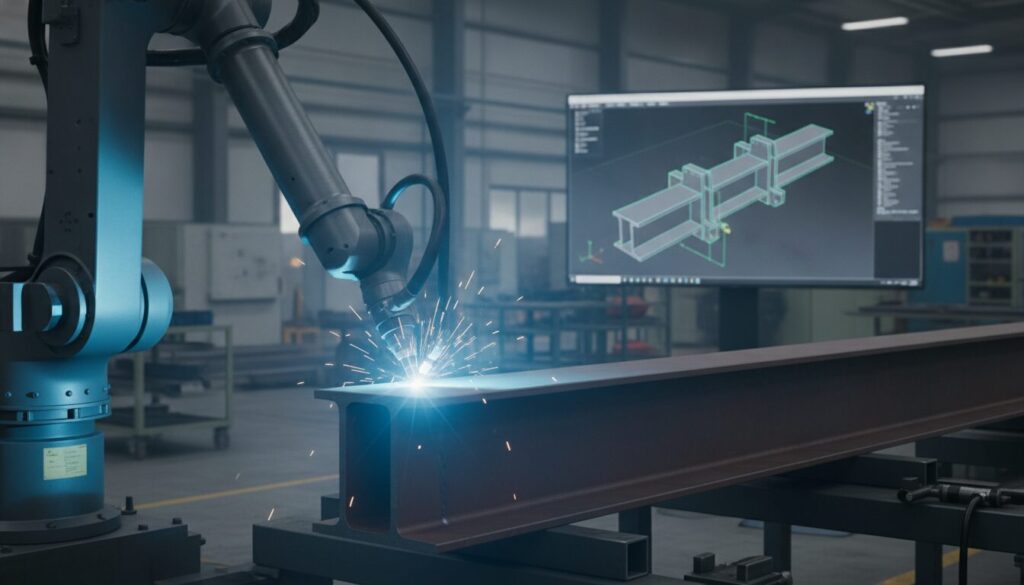
The software now directly guides the 3D structural model to the laser cutting machine and the robot welding arm in the workshop. This blocks all the mistakes that are easy to make when copying data manually. The machine itself reads the exact cutting details, drilling position and welding path. As long as the purchasing manager gives priority to the processing plants that are opened by BIM in the whole process, he will often find that the project is not delayed and the waste of materials is pitifully small.
FAQ
What materials are usually used for steel processing?
Carbon steel has always been the absolute main force because of its high tensile strength and excellent cost performance. If corrosion resistance is required, the processing plant will change to stainless steel. If the project requires both light weight and load-bearing capacity, then high-strength low-alloy steel will be added.
How long does it usually take to process structural steel?
A typical commercial project takes about four to eight weeks from finalizing the final workshop drawings to final delivery to the site. Of course, if the purchase of raw materials is jammed or the welding requirements are particularly complicated, this timetable will have to be calculated separately.
What is the difference between welding and machining?
Welding is just a very specific single action: melting and joining two pieces of metal together with high temperature. Machining is a complete manufacturing large frame, which includes cutting, bending, assembly and final surface treatment.
How to estimate the cost of steel processing?
The estimator calculates this account, looking at the total weight of the raw steel, the complexity of cutting and bending, the number of man-hours spent by certified welders, and the specific surface treatments to be done in the project specification.
Why is CNC machining so critical in steel processing?
The CNC machine completely zeroed out human error during the cutting and drilling stages. It ensures that when you pull the steel beam to the construction site hundreds of kilometers away from the processing plant, each bolt hole will align tightly.
Can processed steel be recycled?
No problem at all. Processed steel is 100 percent recyclable. The removed structural steel can be directly recycled and remanufactured, rolled into a new raw steel product, and its physical properties and strength will not be attenuated at all.