 GAOERJI STEEL


Search
Do Steel Frame Houses Creak
A simple and direct conclusion: if there is no insulation treatment, the steel frame will indeed make the “ticking” or “bang” sound due to thermal expansion and contraction, but in today’s high-quality steel structure houses, this basically does not exist.
Although steel is very sensitive to temperature changes, thermal expansion and cold contraction is a physical iron law, but the noise is not emitted by the steel itself, but the skeleton moves with other materials “hard” rub out.
The good news is, it’s totally prevenable. For friends who are preparing to build a house, the key lies in the number of roads to be built: as long as we correctly install the thermal break bridge, fill high-density insulation cotton, and use the fastening system with nylon washers, we can completely isolate this kind of movement.
Steel Frame Expands And Contracts With Thermal Changes
Steel conducts heat fast. When the sun basks in the outer wall, the steel skeleton inside the wall will expand slightly when heated. At night, the temperature drops and the metal shrinks back. In the framework of no insulation buffer, this “kinetic energy” must have a place to go.

The kind of “ticking” or “popping” sound that owners occasionally report is rarely because the metal structure is broken, but the movement heard when this microscopic displacement occurs too fast. If the steel is directly next to gypsum board, exterior wall hanging board or other hard materials, without a buffer in the middle, this the “slip-stick motion” generated by expansion and contraction, which will make movement. This is similar to the sound made when the engine slowly cools down after the car is turned off.
Again, this is a matter of design and installation craftsmanship, not the pot of the material itself.
The Reason Is Friction With Other Materials
The steel itself is not “noisy. You throw a steel beam into the open ground, where it expands and shrinks won’t hum all day long. The noise comes purely from the friction point.
Specifically in the house, the noise is usually caused by the moving steel frame rubbing against it:
- Gypsum board for interior walls.
- Connectors for exterior panels or brick walls.
- The roof of the metal plate.
If the construction party does not take this “expansion amount” into account, the structure created is that various materials are competing with each other. So the solution is not to violate the laws of physics to prevent the steel from stretching, but to make sure that when it stretches, it doesn’t rub against the rest of the house.
Steel Structure Workshop
Steel Structure Workshops offer versatile designs. Clear Span ensures unobstructed space, while Centre and Intermediate Columns provide economical solutions for wide spans.
Bridge/Steel Structure Bridgeipsum
Steel Structure Bridges utilize high strength-to-weight ratios to achieve long spans where intermediate supports are difficult.Their versatility makes them essential for critical infrastructure connectivity.
Steel Structure Buildings
Steel Structure Buildings feature versatile designs to meet diverse needs. Clear Span offers open space, while Centre and Intermediate Columns increase economy for large spans. Multi Gable accommodates complex widths.
How Modern Technology Can Eliminate Noise
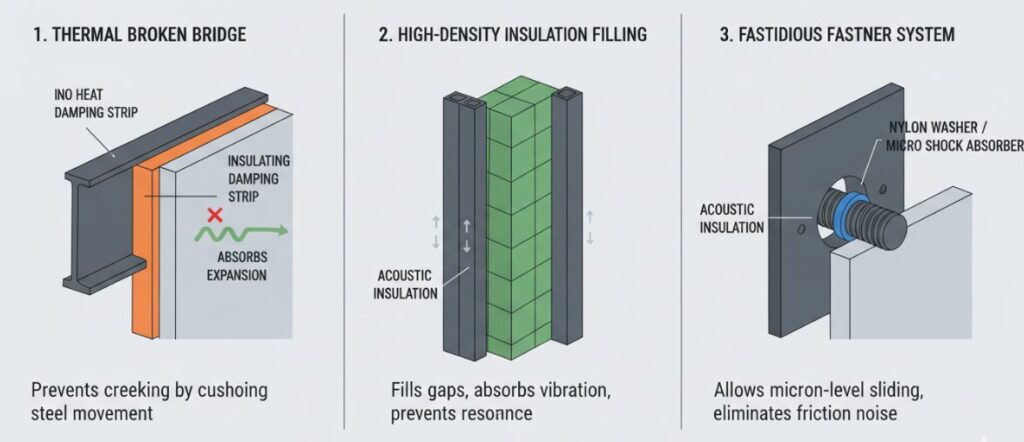
Modern high-standard steel structure houses are basically silent, relying on engineering means to accurately eliminate friction.The following 3 are the most hard-core preventive measures:
Thermal Broken Bridge
This is the most effective trick for “creaking. We attach insulating strips (usually high-density foam or special rubber) between the steel frame and the exterior wall panels:
- Thermal efficiency: Do not let outside heat into the house.
- Sound-absorbing damping: It’s just a cushion. When the steel expands, it is topped by soft foam instead of hard-ground exterior panels, which completely holds down the movement.
High Density Insulation Filling
In addition to the frame, the wall cavity is also important. Modern steel structures are made of high-density insulation cotton, which is tightly sewn between the keels. It’s not just for warmth, it’s also an acoustic absorber. After filling the gap, the thermal insulation cotton will give the frame a little gentle pressure, absorb vibration, and prevent the tiny “ticking” sound from resonating and turning into loud noise.
Fastidious Fastener System
In the early years, the steel frame may be directly screwed on other materials with metal screws, which is the typical “gold and wood” or metal grinding metal.
Now, reliable construction teams will use fastening systems that specifically deal with displacement. This includes the use of nylon washers or plastic collars around the screws and bolts. These inconspicuous small parts are actually miniature shock absorbers, allowing the steel to have micron-level sliding room without jamming the screws, and the sharp friction popping sound will naturally disappear.
The Noise Of Steel Structure Vs. Wood Structure
Finally, we have to give a name to this noise problem and put it down. Many people ask “steel structure room ring not ring”, but forgot to ask how wooden structure.
A well-made steel house is usually quieter than a wooden house. Because wood is a bio-organic material, it absorbs moisture.
- Wood: The tide swells and the sky dries up and shrinks. This can lead to deformation, distortion, the kind of traditional old house floor creak or wall groan, everyone is familiar with it.
- Steel: Extremely dimensionally stable. It will never deform, distort or shrink due to high and low humidity.
As long as the friction problem of thermal expansion and contraction is solved as mentioned above, the steel structure is a more stable and quiet skeleton. The so-called “more noisy steel structure” is purely based on the prejudice of outdated practices. The current engineering performance has long proved that steel can become a solid foundation for a quiet home.
Author: David Miller
With over 16 years in structural engineering, I specialize in light gauge steel framing. My work focuses on optimizing construction methods—specifically using thermal breaks and high-density insulation—to build homes that are structurally sound and acoustically silent.