 GAOERJI STEEL


Search
Can You Live In A Steel Building
Yes, you can absolutely live in a steel building. Converting a steel structure into a primary residence is a legal and increasingly popular trend that can reduce initial shell construction costs by 20% to 30% compared to traditional wood framing. However, to ensure safety and comfort, the structure must meet International Residential Code (IRC) standards. This means you cannot simply inhabit a metal shell; you must obtain a residential permit (not agricultural), install proper thermal breaks to prevent condensation, and ensure the foundation carries residential loads.
The 20-30% Cost Savings
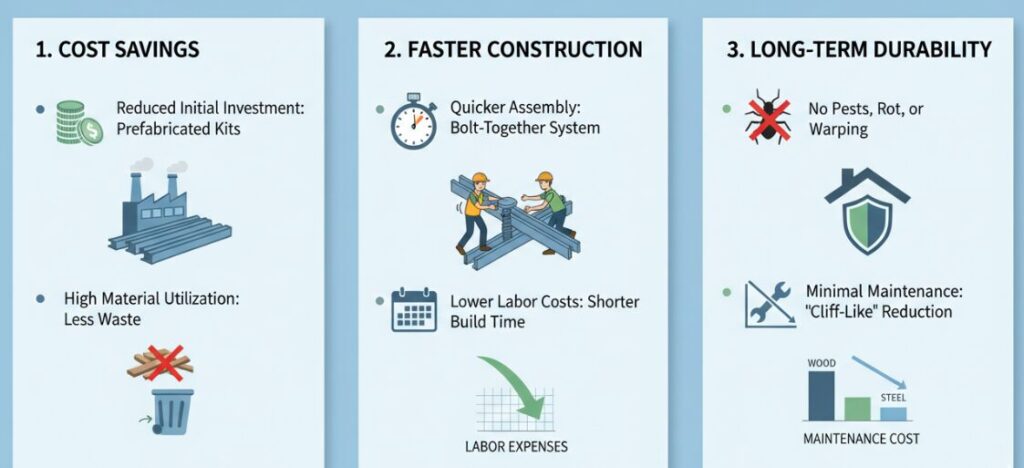
Many people turn to steel structure housing, the most direct motivation is to save money, especially the initial investment of the main structure. In contrast, the efficiency advantage of prefabricated steel structure kits is reflected.
The material utilization rate is extremely high: the steel components are already pre-cut and drilled in the factory. This is critical, and it virtually eliminates on-site waste. Every piece of steel you pay for is spent on the house, not like traditional wood, and you end up having to pay someone to pull away piles of leftover material.
Reduction in labor costs: It is much faster to assemble a steel shell than to build a wooden frame. Because the main structural components are seamlessly connected by bolts, a professional installation team can complete the construction of the weatherproof shell in a very short time. The shorter the construction period, the less time you pay the workers.
Long-term maintenance advantage: In addition to the initial savings, the steel structure also makes me feel at ease in terms of holding costs. They are immune to termites, do not rot, and do not deform. Compared with the wood structure house, the maintenance cost of the later period is almost cliff-like.
Residential Vs Agricultural Permits
Many people think that they can build a metal “barn” and move in quietly. This is absolutely not possible. To legally live in a steel building, you have to get your approval process right from day one.
Agricultural Permit Pits: Agricultural Permits are for sheds where tractors or livestock are stored, not for people to live in. This type of permit has very liberal requirements on insulation, fire protection and escape routes. In most jurisdictions, it is illegal to live in a building with only an agricultural permit. The consequences are often serious-fines, forced evictions, and the most troublesome thing is that in the event of an accident, the insurance company will refuse to settle the claim because of the use.
To define a steel structure as “home,” your local building authority will ask you to apply for a residential building permit. This triggers a rigorous vetting process to ensure that your building is located in a livable area and complies with local safety regulations, such as fire spacing and emergency exit accessibility.
Steel Structure Workshop
Steel Structure Workshops offer versatile designs. Clear Span ensures unobstructed space, while Centre and Intermediate Columns provide economical solutions for wide spans.
Bridge/Steel Structure Bridgeipsum
Steel Structure Bridges utilize high strength-to-weight ratios to achieve long spans where intermediate supports are difficult.Their versatility makes them essential for critical infrastructure connectivity.
Steel Structure Buildings
Steel Structure Buildings feature versatile designs to meet diverse needs. Clear Span offers open space, while Centre and Intermediate Columns increase economy for large spans. Multi Gable accommodates complex widths.
Meeting IRC Standards
For a steel building to be considered a safe home, it must comply with the International Residential Code (IRC). This code sets minimum safety standards for residential construction to ensure that the house can withstand environmental pressures and protect the people inside.
Structural integrity: IRC requires that steel frames must be engineered to withstand wind, snow and earthquake loads in your area. Agricultural buildings usually allow large deformation (shaking) when stressed, but the steel frame of the house must be rigid enough. If the rigidity is not enough, your interior drywall and decoration finishes will quickly crack.
Fire Safety: Steel is non-flammable, which is an advantage under IRC. However, codes may still require the use of specific fire-resistant materials in interior walls, especially in mixed-use buildings (such as “Barndominium” with garages/workshops), which must prevent exhaust gas or fire from spreading to living areas.
Broken Bridge And Condensation Control
Living in a steel structure has a unique challenge that the human body living in a wooden house cannot meet: the thermal conductivity of metal is too strong. If proper intervention is not done, steel-structured houses can become very uncomfortable and susceptible to moisture.
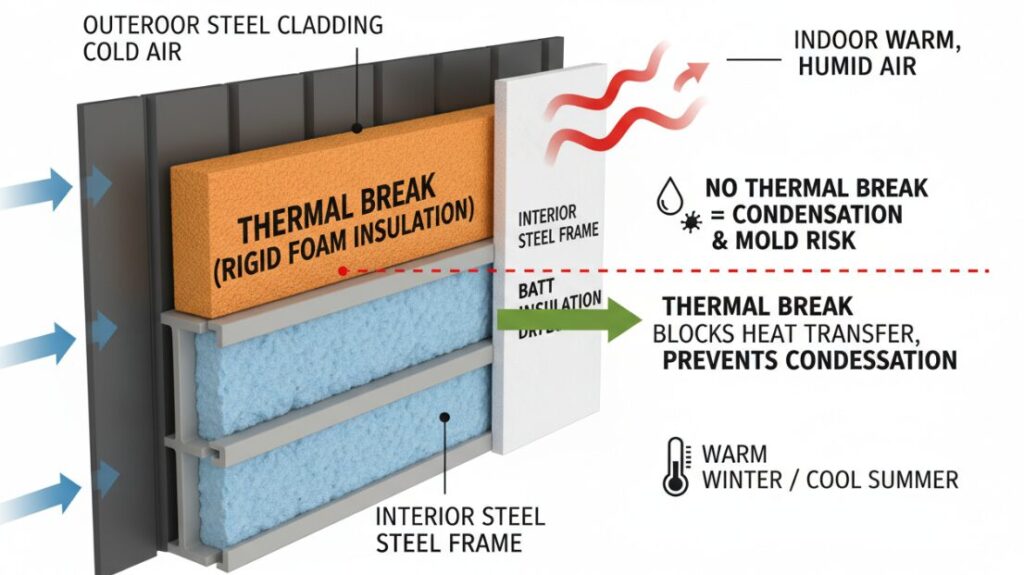
Condensation risk: In steel structures, when the warm air in the room comes into contact with the cold external metal frame, condensation will be generated instantly. This “sweating” phenomenon is very bad, will lead to hidden mold growth, rust, and even let your insulation cotton wet failure.
Install Thermal Breaks: In order to meet residential standards, you must install a broken bridge-a layer of insulation that separates the outer metal plate from the inner steel frame. High-performance solutions, such as continuous rigid foam insulation boards or spray foam, are essential in my opinion. They can block heat transfer, prevent condensation, and ensure that the house is warm in winter and cool in summer, which is where people live.
Requirements Of Residential Load On Foundation
Don’t think that pouring a foundation for a house is the same as pouring a cement board for a storage shed. The two are very different.
Bearing the residential load: The foundation of the house is designed not only to support the weight of the steel shell, but also to support the “live load”-this includes the internal partition wall, the second-floor attic, furniture, electrical appliances, and of course, the people who live in it.
Uplift and anchorage: Steel buildings are much lighter than brick houses, which means they are more susceptible to the “uplift force” of the wind (just like a kite). IRC-compliant foundations often require deeper foundation feet (Footings) and specific reinforcement schemes. The anchor bolts must be accurately embedded in the concrete to fix the steel column, ensuring that your house can firmly “grip” on the ground in bad weather.
Author: Mark Stevens
“I’m Mark Stevens, a structural consultant specializing in alternative residential construction. With over 18 years of experience converting steel structures into habitable homes, I help homeowners navigate complex IRC codes and permitting processes to build safe, cost-efficient dwellings.”