
 GAOERJI STEEL


Search
Can Steel Buildings Withstand Hurricanes
Yes, steel buildings are exceptionally capable of withstanding hurricanes, often surviving wind speeds exceeding 170 mph typical of Category 5 storms. Unlike wood-framed structures that may snap or rot, pre-engineered steel buildings are designed with high ductility (the ability to bend without breaking) and a continuous load path. This means the steel components are mechanically locked from the roof down to the foundation, effectively transferring the extreme uplift and shear forces of a hurricane into the ground, ensuring the structure remains intact even in the harshest weather conditions.
Surviving Category 5 Hurricane Wind Speeds
The primary measure of a building’s ability to survive a hurricane is its ability to withstand high-speed wind loads. When we design steel buildings, we often set the wind resistance at a level that can handle more than 170 mph. This is critical to the durability standard, as it meets or exceeds the definition of a Category 5 storm in the Saffir-Simpson Hurricane Wind Scale.
In practical engineering cases, when the wind speed exceeds the threshold of 110-130 mph, standard building materials often begin to become inadequate. However, prefabricated steel structures are specifically calculated to withstand these extreme wind pressures. The inherent high strength of steel allows engineers to design extremely stable frame systems. These steel frames can remain solid even in the face of the fiercest gusts in the major hurricane belts, which is beyond the reach of ordinary materials.
Ductility Of Steel Structures
One of the most significant advantages of steel over traditional wood frames is its “ductility”. In the context of structural engineering, especially in the face of hurricanes, ductility refers to the ability of a material to undergo slight plastic deformation (bending or flexing) without breaking.
Limitations of wood: Wood is an organic material that, while strong, tends to exhibit brittleness under sudden, extreme lateral pressure. When hurricane winds push it to its limits, the wood frame is prone to snapping, cracking or shattering, which directly leads to catastrophic structural failure.
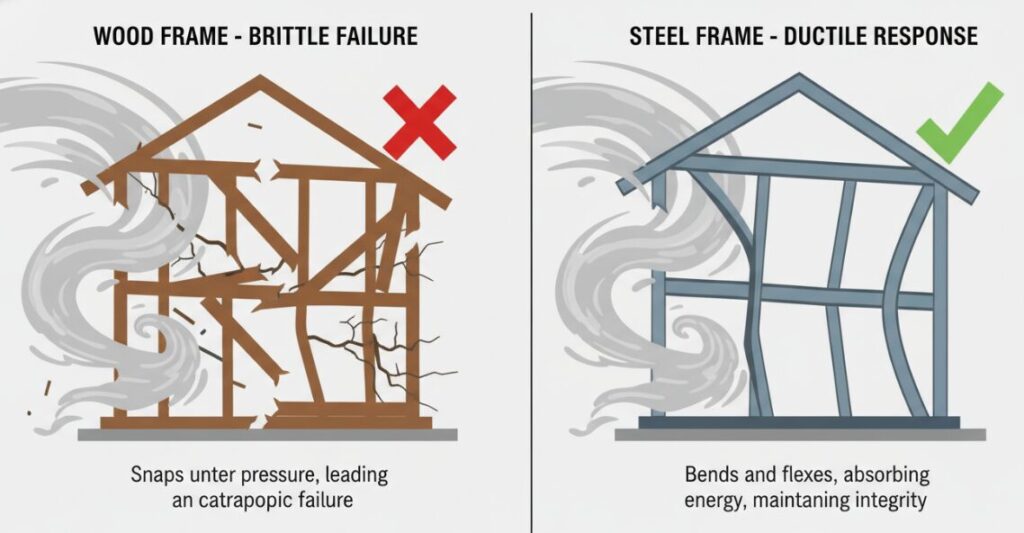
Advantages of steel: Steel combines high tensile strength with high ductility. When a hurricane slams into a steel structure, steel members can absorb energy by bending slightly. This energy absorption mechanism prevents sudden breakage of the frame, allowing the building to maintain its structural integrity throughout the storm. Simply put, it knows how to “overcome the rigid with softness”.
Continuous Load Path
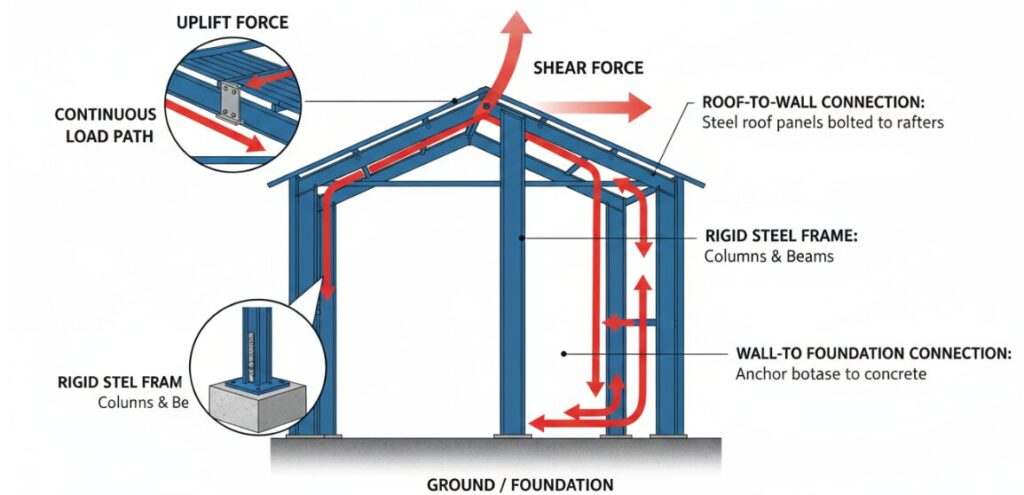
The standing of steel buildings lies in a core engineering principle: the Continuous Load Path.
We often say in the industry, “The strength of a building depends on its weakest connection”. In wooden structures, nails and nails are easily pulled out under high pressure, thus destroying the connection between the roof and the wall.
In contrast, steel structures use a system of mechanical locking, which is essential:
Roof-to-wall connection: Steel roof slabs and purlins are firmly fixed to heavy steel rafters and columns by bolts or screws.
Wall-to-foundation connection: The rigid steel frame is anchored directly in the concrete foundation by heavy anchor bolts.
This creates an uninterrupted chain of strength. When a hurricane generates huge uplift forces (trying to overturn a roof) or shear forces (trying to bring down a wall), this continuous load path can instantly transmit these forces from the roof, through the steel columns, and finally safely dissipate into the ground.
Against Moisture And Rot
Finally, we cannot ignore one point on this issue: structural integrity during a hurricane is not only about wind, but also about water.
Hurricanes are usually accompanied by heavy rains and flooding. Wood frame structures are highly susceptible to decay once exposed to water. Rot degrades the structural fibers of the wood, and over time its carrying capacity is compromised.
Steel is inorganic and is not affected by decay. It won’t warp, swell or rot in the face of rain from hurricanes. This is significant for long-term safety-it means that our initial structural calculations for wind resistance are still valid many years later, because the material itself does not degrade like organic alternatives.
Author: Carter
“With over a decade of experience in the pre-engineered metal building industry, I specialize in structural resilience and storm safety. My passion is helping property owners understand the engineering science—like ductility and continuous load paths—that keeps steel structures standing when extreme weather hits.”
