
 GAOERJI STEEL


Search
Are Steel Frame Houses Noisy
Simply and directly answer you: no – as long as the construction is up to standard, a modern light steel structure house will never have noise.
While untreated steel does produce that kind of “ticking” sound due to thermal expansion and contraction, in residential construction, we have already completely solved this problem through thermal break bridges, correct insulation layer filling, and shock absorption installation technology. Because steel does not warp, shrink, or creep like wood, light steel villas are quieter than traditional wooden houses after long-term residence. You don’t have to worry about the crunching of the floors of old wooden houses.
To be clear: If you hear noise in a steel house, it’s not a defective material, it’s a construction problem.
The Reason For The Existence Of The “Tick” Sound
One of the biggest misconceptions about light steel keels is that they always feel like a tin roof on a hot day, making a loud crackling sound.
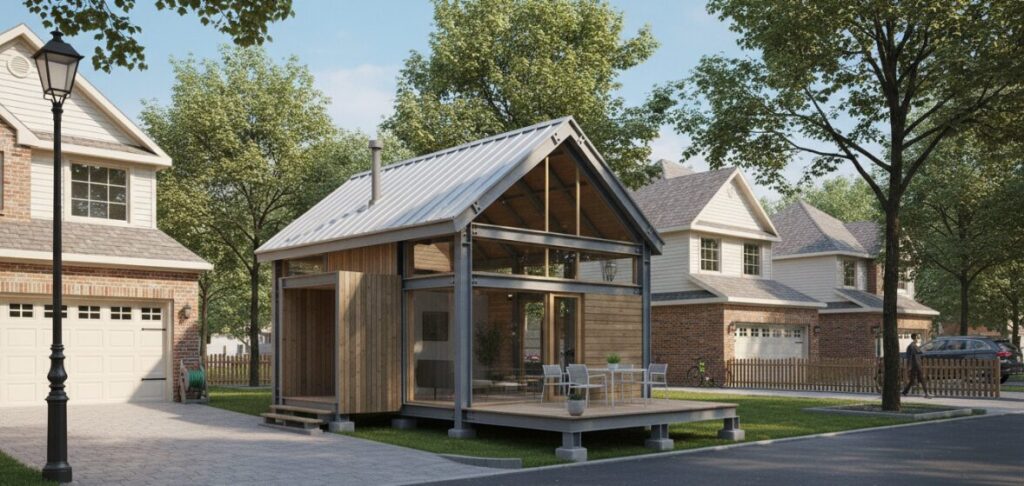
Indeed, from a physical point of view, it is an objective fact that the raw material steel expands in case of heat and contracts in case of cold. In those old-fashioned commercial buildings or tin sheds without insulation measures, the steel is directly exposed to the natural environment. This deformation will indeed produce friction with other materials and make a clear “ticking” sound.
But in residential construction, the situation is completely different. Modern engineering design prevents this thermal motion from becoming audible noise through an “acoustic isolation mechanism.” Engineers have long considered this when designing wall systems – we want to make metal move “silently” and eliminate the friction that produces sound.
Solution: Thermal Broken Bridge, Insulation, And Decoupling
In order to ensure that steel houses are as quiet as traditional houses – or even quieter – we will strictly follow industry standards in our construction and use these three key technologies:
- Thermal Breaks: This is an insulating barrier placed between the external cladding and the steel keel. They prevent external extreme heat or cold from being transferred directly to the steel column. By adjusting the temperature of the frame, the amplitude of expansion and contraction is greatly reduced, thereby “pinching” the noise at the source.
- High-density insulation layer: The wall cavity is tightly filled with high-density insulation materials (such as rock wool or glass fiber), which is not only for insulation but also acts as a damper in acoustics. It can absorb vibration and prevent sound waves from echoing in the hollow part of the keel.
- Damping pendant: “Decoupling,” in popular terms, is to separate two materials so that vibration cannot be transmitted. In the construction of high-quality steel structures, we use elastic keels or shock-absorbing clips when installing gypsum boards. This means that even if the steel structure moves slightly, this vibration will not be transmitted to the walls of your living room, and the interior will still be quiet.
Steel Structure Workshop
Steel Structure Workshops offer versatile designs. Clear Span ensures unobstructed space, while Centre and Intermediate Columns provide economical solutions for wide spans.
Bridge/Steel Structure Bridgeipsum
Steel Structure Bridges utilize high strength-to-weight ratios to achieve long spans where intermediate supports are difficult.Their versatility makes them essential for critical infrastructure connectivity.
Steel Structure Buildings
Steel Structure Buildings feature versatile designs to meet diverse needs. Clear Span offers open space, while Centre and Intermediate Columns increase economy for large spans. Multi Gable accommodates complex widths.
Steel Vs. Wood: Why Steel Is Quieter In The Long Term
When many people struggle with the sound of steel expansion, they often ignore the noise caused by wood aging. This is precisely where steel has an advantage in long-term acoustic performance.
- No warping or shrinkage: Wood is an organic material, and moisture content is a big problem. Over a few years, as the wood dries, it shrinks and warps. This deformation can cause the nails and connection points that hold the house to loosen.
- Eliminate the “crunch” sound: The classic “floor crunch” in an old house is essentially the sound of wood rubbing against wood, or nails moving through dry wooden holes.
- Structural Integrity: Steel is inorganic and extremely dimensionally stable. It doesn’t shrink, it doesn’t warp, it doesn’t rot, it doesn’t settle. The shape of a steel beam today is the same 50 years later. Because the frame maintains a precise shape, the connection points are always tight, directly eliminating the crunch and popping sound caused by friction that plagues aging wooden houses.
It’s A Construction Problem, Not A Material Defect
In the final analysis, the bad reputation of light steel houses being “noisy” usually stems from poor craftsmanship, not the materials themselves. If the owner hears abnormal noise in a newly built steel structure house, it can only mean that the builder did not comply with modern installation specifications.
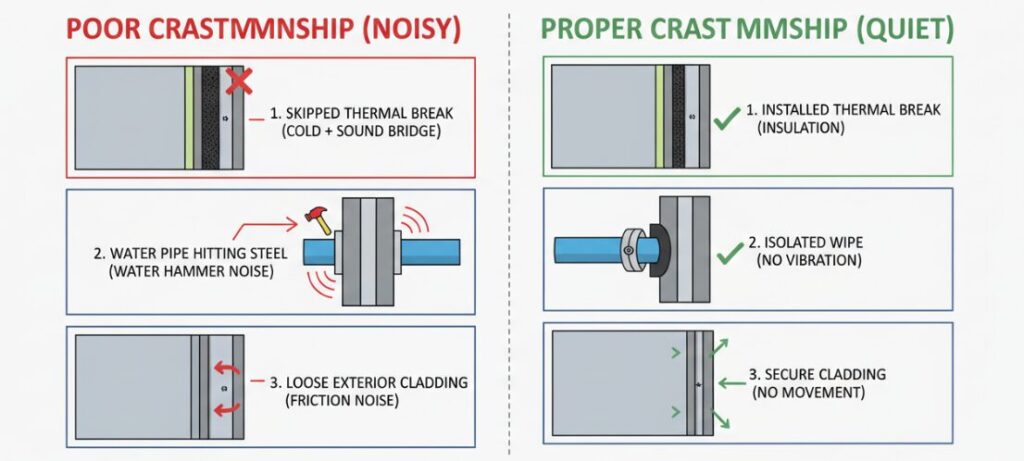
Common low-level errors I’ve seen include:
- In order to save money and trouble, the thermal bridge breaking process was directly skipped.
- Let the water pipe directly contact the steel keel, and there is no additional isolation rubber pad (causing the sound of “water hammer effect” to be conducted along the keel).
- The exterior cladding is improperly fixed, leaving room for friction movement.
As long as the use of thermal bridge and insulation layer in accordance with the standard construction, steel structure housing can provide a very strong and quiet living environment, in acoustic comfort, often better than traditional materials.
Author: Mark Stevens
“With over 14 years as a licensed structural engineer specializing in residential steel framing, I’ve overseen the construction of hundreds of modern steel homes. My expertise lies in building physics and acoustic isolation techniques. I write to debunk common myths and help homeowners understand how proper engineering—specifically thermal breaks and decoupling—ensures a home is not just durable, but exceptionally quiet.”
