 جاورجي ستيل


بحث
تصنيع وتركيب الهياكل الفولاذية على يد خبراء
Say goodbye to tens of millions of trial and error costs: “integrated” customs clearance guide for steel structure manufacturing and hoisting
In order to truly achieve “zero rework” in steel structure construction, it is far from enough to rely on high-precision manufacturing in the factory. It must be closely matched with the heavy lifting on the construction site. In reality, the total contractor (EPC) and industrial real estate developers are burning millions of dollars every year due to dimensional conflicts caused by the disconnection between factory manufacturing and on-site installation.
If the manufacturing and on-site hoisting of steel structures are packed and handed over to the same family through a “turnkey” contract, the mines with mismatched tolerances can be fundamentally pulled out, not only the construction period risk is greatly reduced, but also the budget can be completely controlled. The following set of practical guidelines, let’s take a good look at the 1 set, how the top structural team is to handle heavy infrastructure, completely bid farewell to the traditional subcontracting model of those headaches of procrastination.
Why Splitting The Contract Will Eat Up Your Profits?
The hard-breaking of 1 large project into “manufacturing” and “installation” contracts is simply digging holes for budget overruns, because structural tolerance mismatches are almost certain. If you think about it, even if the bolt hole distance in the factory is 5mm, the heavy crane will have to stop work immediately when it reaches the scene. Workers had to re-erect scaffolding on site, do the grinding and re-welding that were not at all planned. This burn is real gold and silver.
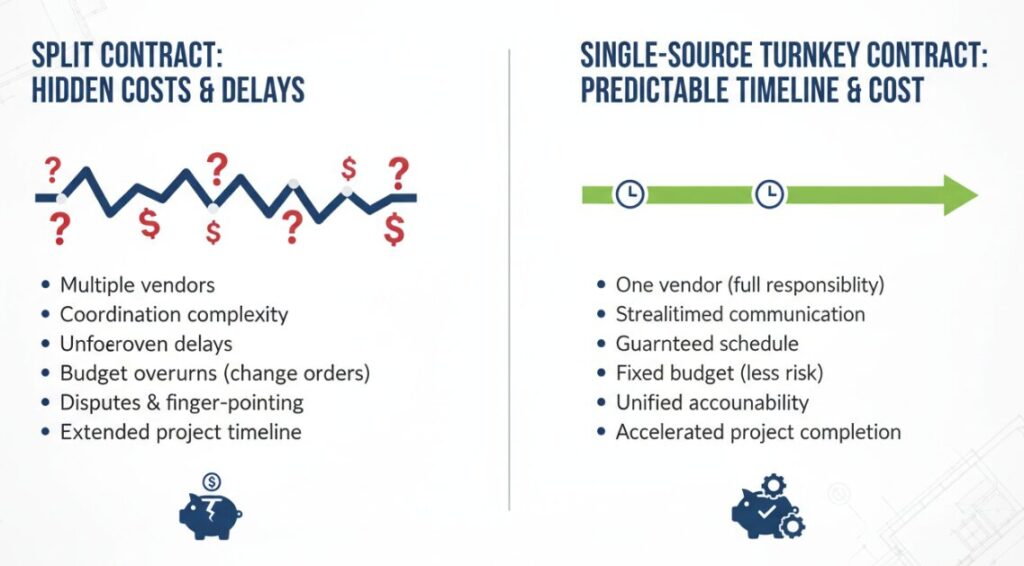
Finding a supplier to turnkey is tantamount to transferring the risk of all dimensional deviations to them, as the deepening drawings and the hoisting sequence on site are fully open. The best thing for investors is that they don’t have to look at factories and construction teams-the same team must be fully responsible for the final architectural form. This high degree of synergy ensures that every piece of steel made in the factory is tailor-made for faster and safer hoisting on site.
E.P.I.C. System For Hardcore Delivery
In the face of high-risk industrial projects, how to turn 1 heaps of pig iron into a tightly fitting building skeleton? This requires a systematic approach. We use our proprietary E.P. I .C. methodology to connect structural engineering, large tonnage manufacturing and lifting logistics.
BIM 5D pre-demining
Before cutting the 1 steel plate, the digital twin technology had already run the whole hoisting process 1 times in the computer. Collision checks are performed by software to identify possible physical conflicts between steel beams, electromechanical lines and temporary lifting lugs in advance. In the digital world, these “fights” can avoid catastrophic rework stagnation in the manufacturing phase.
Manufacture of steel structures with precision
Heavy-duty CNC machining is the bottom line. It must be ensured that every 1 columns, H-beams and node plates are stuck within the tolerance red line of AISC or EN 1090. For large quantities of industrial orders, automatic submerged arc welding must be required, with deep penetration and small thermal deformation, and the qualified rate of key load-bearing nodes can be directly filled. Before the components are sent for painting, the quality inspection team has to take ultrasonic and magnetic particle inspection 1 times to ensure that the weld is safe.
Logistics linkage and virtual pre-assembly (VTA)
Traditional pre-assembly of factory entities costs money and occupies an area, but now it is done directly with 3D laser scanning. The technician sweeps 1 the completed giant truss in the workshop and directly “virtual splicing” in the software to confirm the tolerance. After passing the standard, all components shall be barcoded and sent to the construction site in strict accordance with the daily lifting plan of the crane driver on site.
On-site hoisting of precision control field
How to stand the crane and how to determine the lifting radius are calculated in advance, which can not only ensure the efficiency of on-site workers, but also avoid fatal safety risks. For those complex modular hoisting, engineers will accurately calculate the center of gravity offset to ensure that the truss weighing several tons is stable in mid-air. Ground personnel will first assemble small components into large modules and then lift them. This method can greatly reduce the time for workers to tighten bolts when hanging in dangerous places at high altitude.
Actual Combat: Hard Core Shortens The Construction Period Of Heavy Industrial Plant By 45 Days
A while ago we just delivered a 50000 square meter heavy manufacturing plant project. At that time, the owner’s heavy equipment was about to enter the site, and the dead line was very tight. By getting the manufacturing and installation workflow through, we just robbed the customer of a 45-day construction period.
| مرحلة المشروع | الجدول الزمني المتوقع (عقد مقسم) | الجدول الزمني الفعلي (مشروع جاهز للتسليم) | عدد الأسابيع التي تم توفيرها |
| التفاصيل | 8 أسابيع | 5 أسابيع | 3 أسابيع |
| التصنيع | 10 أسابيع | 7 أسابيع | 3 أسابيع |
| الانتصاب | 6 أسابيع | 4 أسابيع | أسبوعان |
| المدة الإجمالية للمشروع | 24 أسبوعًا | 16 أسبوعًا | 8 أسابيع |
We transferred 30% of the assembly work on site to the factory where the conditions are absolutely controllable in advance, directly avoiding the interference of harsh tianqi111 on site. In the factory drawing stage, the engineer also specially increased the size of some splicing plates-with this action, the on-site team achieved structural self-reliance and stability 40% faster than the conventional practice.
Frequently Asked Questions (FAQs)
What is the essential difference between “manufacturing (Fabrication)” and “installation (Erection)” of steel structures?
In simple terms, manufacturing is carried out in a controlled factory, where raw steel is cut, welded, and processed into formed components such as columns and beams. The installation is a job on the construction site. The completed components are hoisted to the designated position by a crane, and then bolted or welded to form the skeleton of the whole building.
Why should EPC general contractor find a company to “wrap up” manufacturing and installation?
The biggest advantage is that there is less wrangling, the problem of tolerance mismatch is completely eliminated, and the progress can be completely occlusive. The components completed by the factory will be loaded and delivered in the order required for hoisting on site. In this way, the construction site is not only not blocked, but also saves the extremely expensive crane idle fee.
How long does it take for a standard industrial plant to manufacture steel structures?
If you want to deal with the steel of a 10,000 square meter factory, it usually takes 6 to 8 weeks, which mainly depends on the stock of raw materials and the complexity of CNC machining drawings. However, if you use automatic steel production lines and welding robots, this cycle can be greatly compressed.
What is the black technology of “virtual pre-assembly (VTA)” in steel structure manufacturing?
VTA uses a 3D laser scanner to measure the components made in the factory and then connects them virtually in the computer. In this way, it can be 100% confirmed that the fit is perfect before delivery, and it is no longer necessary to twist the huge truss entities together in the open space of the workshop, thus saving both money and space.
How do engineers ensure safety when hoisting heavy steel structures?
Safety mainly depends on the precision engineering calculation before lifting. The accurate center of gravity must be calculated and then combined with the modular assembly of the ground. On the ground as far as possible to put together large modules and then lift them up, it can minimize the time for workers to stand in high-altitude hanging baskets for complex bolting operations, and directly reduce the risk of high-risk operations from the source.