
 GAOERJI STEEL


Search
How To Insulate A Steel Frame Building
If you want to completely fix the insulation of steel buildings, you must first solve the “natural defect” of high thermal conductivity of metals “. In actual operation, if you do not use the “continuous insulation” strategy to cut off the thermal bridge, then your insulation work is basically only half done.
The safest and most efficient way for self-building owners or DIY players is the “two-step” mixed scheme: first, cover a layer of rigid foam board or closed-cell spray foam on the surface or outside of the steel column to establish an airtight layer and block the thermal bridge; Next, fill the wall cavity with high-density rock wool or glass wool, put the overall R value up.
The reason why this combination is emphasized is that steel is simply a “highway” of heat “. If you don’t completely decouple it from the external environment, even if you plug the thick insulation cotton in the keel, its actual insulation performance will shrink by as much as 50% due to the thermal bridge effect. Moreover, you also have to cooperate with high-quality vapor barrier and extremely tight airtight sealing. Water vapor is the enemy of metal buildings. If it is not handled properly, it will congel. When the time comes, rust and mildew will be enough for you to have a headache.
Why Can’t Steel Structure Copy The Traditional Thinking
The steel structure is indeed resistant to operation and high strength, but it is very difficult to perform thermodynamically. It’s not the same thing as wood. In those steel structure rooms that do not have the right insulation, the metal keel is like a “heat straw”. The heat will directly bypass the insulation cotton and escape to the outside along the frame.
To be honest, if you still follow the traditional idea of “stuffing cotton into the keel”, it is basically a waste of money, because the thermal bridge will steal half of your insulation effect.
Core Logic: Continuous Insulation (CI)
Steel Structure Workshop
Steel Structure Workshops offer versatile designs. Clear Span ensures unobstructed space, while Centre and Intermediate Columns provide economical solutions for wide spans.
Bridge/Steel Structure Bridgeipsum
Steel Structure Bridges utilize high strength-to-weight ratios to achieve long spans where intermediate supports are difficult.Their versatility makes them essential for critical infrastructure connectivity.
Steel Structure Buildings
Steel Structure Buildings feature versatile designs to meet diverse needs. Clear Span offers open space, while Centre and Intermediate Columns increase economy for large spans. Multi Gable accommodates complex widths.
Now the cornerstone of the field of building energy efficiency is “continuous insulation”. To put it bluntly, it is to wrap the outer frame of the building with a layer of thermal insulation to completely separate the steel frame with strong thermal conductivity from the outside temperature. This approach is not only to save the electricity bill, but more importantly, it allows the entire frame to maintain a relatively constant temperature, which is very helpful to protect the safety of the structure.
Recommended Scheme: Two-Step Mixed Insulation Method
To balance cost and performance, I usually recommend this hybrid strategy:
1. Use rigid foam or spray foam to establish thermal bridge blocking
This is the core step. You can either install XPS or Polyiso this rigid foam board on the outside of the steel keel to make a seamless insulation shell, or use closed-cell spray foam.
- Rigid foam board: This solution can form a complete thermal envelope.
- Closed-cell spray foam: This thing can provide a very high single-inch R value, and excellent air tightness, but also can act as a second moisture barrier.
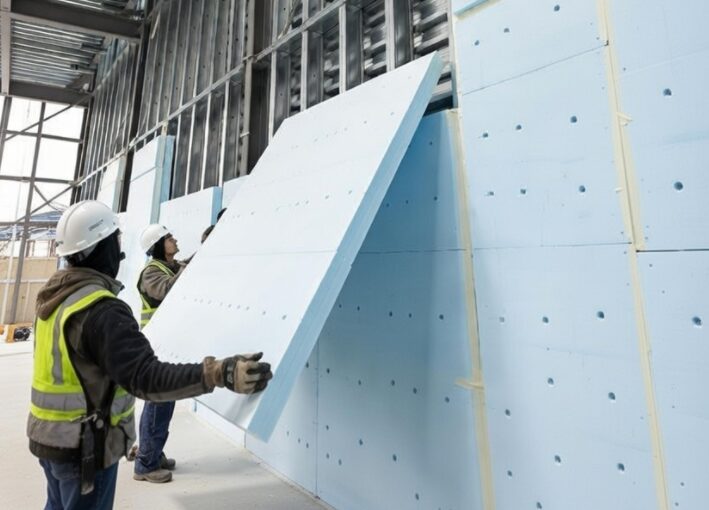
2. Filling the cavity to increase the R value
After the thermal bridge is cut off, all that remains is to fill the wall cavity. High density rock wool or glass wool is preferred. Personally, I prefer rock wool. Although it is heavier, its fire rating and sound insulation effect are very advantageous in steel structure buildings.
Vapor Management And Air Tightness
When the warm and humid air in the room meets the cold metal surface, dew will immediately form, followed by rust and decay.
- Vapor barrier: This must be installed and placed in the right position so as not to let moisture touch the steel frame.
- Airtight sealing: door and window joints and material joints must be sealed with special adhesive tape. If the air is scurrying around, the effect of your “external insulation” strategy will be greatly reduced.
The Ultimate Goal: Control Dew Point
The biggest advantage of this hybrid solution (or “external insulation” technology) is that it controls the “dew point”. By moving most of the insulation to the outside of the steel frame, you are actually pushing the dew point-that is, the critical temperature point at which water vapor condenses into water-out of the structural wall.
As long as the steel frame is always wrapped in a warm “insulation sleeve”, it will not congee. This not only makes the indoor environment more stable and dry, but also easily passes the most stringent modern building codes. This is the safest way to extend the life of the house.
Author: Marcus Thorne
“With over 16 years of experience in structural engineering and sustainable construction, I specialize in optimizing the thermal performance of metal-framed structures. My work focuses on bridging the gap between durability and energy efficiency, helping DIY builders and professionals navigate the complexities of thermal bridging and moisture management. I’ve dedicated my career to perfecting ‘outsulation’ techniques that ensure steel buildings remain dry, comfortable, and compliant with the highest modern energy standards.”
The prev: Do Steel Frame Homes RustThe next: Why Use Steel Frame Construction
Related recommendations
-

Why Steel Structure Construction Is More Preferred
28Learn Why Commercial And Industrial Projects Choose Steel Structures For High Strength, Fast Peb Assembly, And Low Costs.
View details -
How To Calculate Structural Steel Quantity
14Master Structural Steel Take-Offs With This Expert Guide On MTO, BOQ, Waste Factors, And BIM For Precision.
View details -
Differences Between H-Beam, C-Channel, and Z-Channel Steel
317Shaped like the letter “H,” it provides excellent load-bearing capacity and is commonly used for main factory frames, bridges, and high-rise structures. Lightweight and shaped like the letter “C,” it is often used for roof purlins and wall be...
View details -
How To Build A Steel Bridge
32Learn The 5 Steps Of Steel Bridge Construction: From Geotechnical Assessment And Prefabrication To Final Inspection.
View details




HelloPlease log in