 GAOERJI STEEL


Search
How To Ventilate A Steel Building
In order to effectively ventilate residential steel buildings or workshops, one core logic is: the use of the “chimney effect”. Simply put, it is to combine the high exhaust point with the low intake.
The safest solution is to install a continuous ridge vent or heavy turbine ventilator (also known as “unpowered hood”) at the highest point of the roof, so that the rising hot air has an outlet. At the same time, you need to install adjustable shutters or windows on the lower 1/3 of the wall—preferably the windward side—to bring in cooler fresh air.
In addition, I must remind you that ventilation alone cannot solve the common “indoor rain” (condensation) problem. To cure this problem, the air flow must be used with the moisture-proof layer or radiation insulation layer to prevent moisture from directly contacting the cold color steel plate. As for the specific ventilation volume, for the standard workshop, my suggestion is to complete the whole house ventilation every 30 to 60 minutes. Moreover, the area of the air inlet (square feet) should be at least 10% larger than the exhaust area, so as to maintain a slight positive pressure and prevent dust from flowing back.
Understanding The “Chimney Effect”
Understanding the physics of air flow is the first step in studying how to ventilate a steel building.
Steel structure has a characteristic, heat absorption is very fast. When the indoor air becomes hot and the volume expansion becomes lighter, it will naturally go to the ceiling. This is the so-called “chimney effect”. Under this natural mechanism, if you don’t leave a way for the hot air accumulated at the top of the roof, the heat will accumulate in layers and the indoor temperature will directly soar.
But many people only stare at the “exhaust” and ignore the other half—exhaust is not enough. At the same time, the hot air will produce a vacuum effect, and colder and denser air must be added from below. This is the complete cycle, which can achieve continuous passive cooling without relying on large amounts of electricity.
Installing High Exhaust Point
The most efficient way to exhaust is to use the highest point of the roof. In actual engineering, there are two main options:
Continuous ridge tile ventilators: installed directly on the ridge line. This solution has a smooth line appearance and can provide uniform ventilation along the entire length of the building. If you are more concerned about the aesthetics of residential steel structures, or worry about the risk of water leakage, I usually push this first.
This video demonstrates how to install Turbine Ventilator:
Turbine ventilator: This is a device that uses wind power to drive. Even if there is only a little breeze, the rotation of the turbine will actively “pump” the hot air out. This kind of equipment is indeed a “heavy” player with a large exhaust volume, but the sealing treatment must be in place during installation, otherwise it is easy to enter water in stormy weather.
The core task of both options is to pull out the lid of the “chimney” and let the thermal buoyancy drive the ventilation process.
Deploy Low Air Inlet
For the chimney effect to run, you have to provide a source of supplemental air. The location of the intake is actually as critical as the exhaust, and even easier to ignore.
- The following 1/3 principle: Air inlets such as adjustable blinds or windows should be installed at the lower 1/3 of the wall height. This allows the cold air to be introduced directly into the ground floor where the personnel are working.
- Windward face orientation: If conditions permit, the air inlet is located on the side of the dominant wind direction for the best effect. The wind pressure will push cold air into the room and accelerate the squeezing of hot air up the roof and out.
I recommend using adjustable blinds so that you have control: off in extreme cold weather and full on in summer heat.
Steel Structure Workshop
Steel Structure Workshops offer versatile designs. Clear Span ensures unobstructed space, while Centre and Intermediate Columns provide economical solutions for wide spans.
Bridge/Steel Structure Bridgeipsum
Steel Structure Bridges utilize high strength-to-weight ratios to achieve long spans where intermediate supports are difficult.Their versatility makes them essential for critical infrastructure connectivity.
Steel Structure Buildings
Steel Structure Buildings feature versatile designs to meet diverse needs. Clear Span offers open space, while Centre and Intermediate Columns increase economy for large spans. Multi Gable accommodates complex widths.
Solving The Problem Of “Indoor Rain” With Insulation
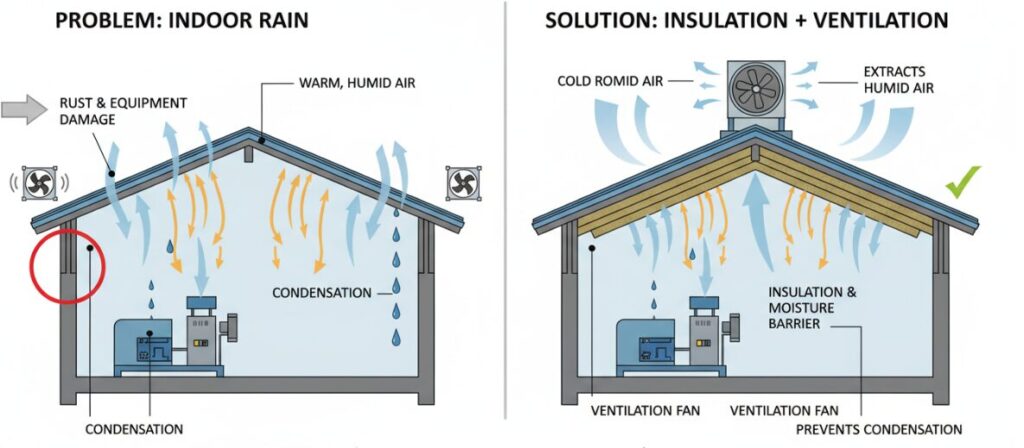
Ventilation can take away the air, but it can’t solve the condensation problem alone, which is the “indoor rain” that everyone often complains about”. Condensation occurs when the warm, moist air in the workshop hits the cold roof or wall panels.
To prevent this, the ventilation system must be matched with a moisture barrier or radiant insulation:
The role of the insulation layer: acts as a thermal break bridge. Its function is to physically block, not to let the humid indoor air directly touch the cold steel plate.
The role of airflow: to carry away humidity before it accumulates to a critical point.
If you don’t combine the two, even if you install a top-level ventilation system, you may still see water dripping down. After a long time, the steel structure will rust and the equipment will be damaged sooner or later.
Calculation Of Ventilation Rate And Positive Pressure
For a standard workshop environment, don’t rely on feeling, we need to accurately calculate the size of the vent to ensure air quality.
- Ventilation rate: The goal is to replace all air in the room every 30 to 60 minutes. This frequency can effectively prevent dead air bags and control humidity.
- 10% Proportionality Principle: When opening vents, make sure that the total intake area is at least 10% larger than the exhaust area.
Why? If the air inlet is smaller than the air outlet, negative pressure will form inside the building, which will suck dust and allergens through every gap like a vacuum cleaner. On the contrary, make the air inlet bigger, can form a micro positive pressure. This ensures that the air is “pushed” out of the gap instead of “pulling” the dust in, so that your workshop can keep clean and the airflow is more stable.
Author: Jason Miller
” With over 13 years of experience in metal construction and workshop design, I specialize in optimizing steel structures for longevity and comfort. I focus on practical, physics-based solutions like thermal buoyancy to help owners banish condensation and maintain the perfect airflow in their buildings.”