
 GAOERJI STEEL


Search
What Foundations Are Used For Steel Framed Buildings
The answer depends entirely on 3 hard metrics: the span of the structure, the geological conditions, and your budget.
However, in actual engineering, whether it is a commercial warehouse or the popular “barn-style residence” (Barndominiums), our range of choices usually cannot run out of these 4: raft foundation, independent foundation , strip foundation and pile foundation .
Let me quickly summarize these 4 positions:
- Raft foundations: the most “cost-effective” option for light industrial and residential steel structures. The bottom plate and foundation are poured and formed at one time, saving labor and time.
- Independent foundation : the “standard answer” in the large-span steel structure regulations “. Designed to independently support large column bottom loads.
- Strip foundation : This is most suitable when your steel structure contains heavy masonry or brick walls.
- Pile foundation: “last resort” when encountering very poor soil (such as soft clay), responsible for transmitting the load to the deep underground.
Tip: It’s completely different from traditional wood structures. Although the steel structure has high strength, it has light weight, which leads to a problem that many people easily overlook: wind suction. Your foundation is not only to “hold” the house to live, but also to “drag” the house to live. If the foundation design cannot resist this upward pulling force, the structure will have problems.
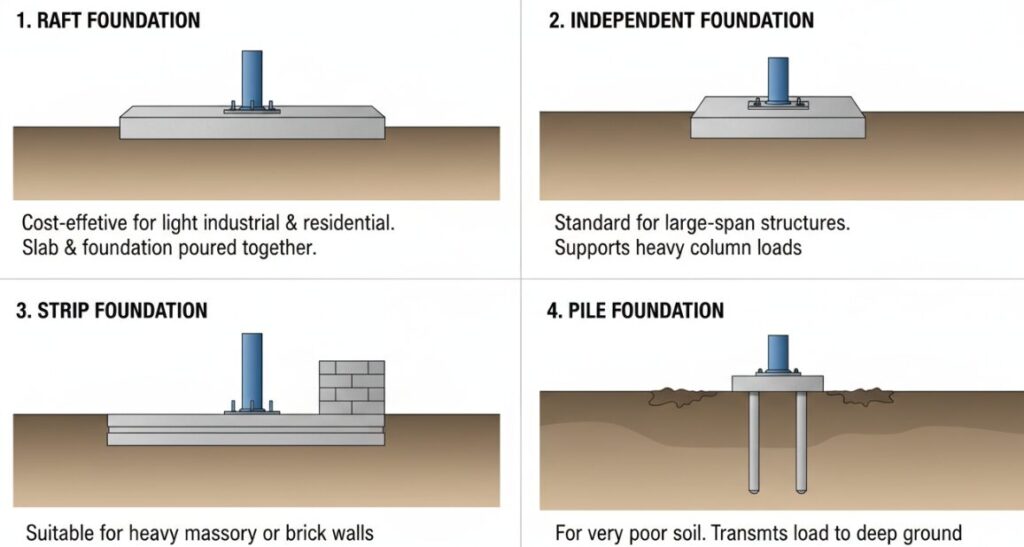
Below we will disassemble these 4 foundations in detail:
Raft Foundation: Cost-Effective Choice
When asked what kind of foundation is used for steel structure, I usually give raft foundation first for garage, workshop or residential steel structure projects.
Its principle:
This approach is the foundation and the ground floor in a concrete pouring operation at the same time. We will thicken the concrete at the edges (making haunches) to support the steel columns and walls, while the ground in the middle will maintain a standard thickness.
Why choose it:
From the perspective of project control, it only needs one formwork support, and the concrete tanker can run 1 times, which can greatly reduce the labor cost and construction period. It’s like “floating” on the soil. As long as the foundation soil is stable and there is no particularly exaggerated point load, this is the most economical solution.
Steel Structure Workshop
Steel Structure Workshops offer versatile designs. Clear Span ensures unobstructed space, while Centre and Intermediate Columns provide economical solutions for wide spans.
Bridge/Steel Structure Bridgeipsum
Steel Structure Bridges utilize high strength-to-weight ratios to achieve long spans where intermediate supports are difficult.Their versatility makes them essential for critical infrastructure connectivity.
Steel Structure Buildings
Steel Structure Buildings feature versatile designs to meet diverse needs. Clear Span offers open space, while Centre and Intermediate Columns increase economy for large spans. Multi Gable accommodates complex widths.
Independent Foundation: Large Span Industry Standard
If you are planning a large agricultural building, a hangar, or a heavy industrial warehouse, an independent foundation is usually a mandatory requirement for structural engineers. Unlike rafts, which distribute the weight evenly, large steel frames transmit the enormous pressure centrally through each 1 of vertical steel columns-this is the “point load” we are dealing “.
Its principle:
We dug deep into the ground and poured a separate reinforced concrete block (that is, a pier) directly below each steel column. Steel columns are bolted directly to these piers.
Why choose it:
The essence of this system is “isolation”. It separates the structural support from the ground floor. You can pour the floor later, and even if you want to save money, it’s no problem to keep the dirt floor directly. This is the most efficient way to deal with the huge downforce brought by the large span frame.
Strip Foundation: Scheme With Masonry Wall
Although the steel structure is mainly stressed by the pillars, some designs will add heavy bricks, blocks or stone as the exterior wall. In the case of this “mixed structure”, we must have a strip foundation (or continuous foundation).
Its principle:
This is like pouring a continuous strip of concrete along the entire perimeter of the building. It provides a horizontal, continuous base to support the heavy weight of the entire masonry wall.
Why choose it:
If your steel structure design has brick facades for aesthetics, or heavy blocks for security and insulation, independent foundation piers alone are not enough. Strip foundations ensure that these heavy walls do not crack or sag due to uneven settlement of the soil.
Piled Foundations: The “Last Resort” To Deal With Bad Geology”
This is often the case in dry engineering: the commercial site is perfectly located, but the geological report 1 is full of mud. If the foundation is soft clay, quicksand, or the previous backfill soil, do ordinary shallow foundation will definitely settlement failure. At this time, we have to use the pile foundation.
Its principle:
Long concrete or steel columns are driven deep into the ground until they touch hard bedrock or soil with sufficient bearing capacity. Then the steel structure sits on these piles, which is equivalent to directly “bypass” the weak soil on the surface.
Why choose it:
This is the most expensive option. But it is also the only safe option in bad geological conditions. It prevents dangerous settlement or displacement of the building over time.
Why Did “Wind Suction” Change Everything?
When deciding on the foundation of a steel structure, many owners only look at the “load-bearing” . But as I mentioned at the beginning, wind suction is the unique fatal factor of steel structure.
Steel structures, while extremely durable, are relatively light compared to concrete or heavy wood structures. In strong winds, the huge roof area generates lift like a wing.
- Danger point: The suction created by strong winds will try to “pull” the entire building off the ground.
- Solution: Your foundation must be heavy enough and buried deep enough to act as an anchor. The connection between the foundation and the steel column must be subjected to special anti-pull calculation.
About the Author
I’m a Senior Structural Consultant specializing in pre-engineered steel buildings. With over 14 years of experience in the construction industry, I help business owners and homeowners select the right foundation to ensure their structures stand strong against wind uplift and challenging soil conditions.
