
 GAOERJI STEEL


Search
How To Frame A Steel Building
If you want to erect a steel structure building smoothly, the first step is not to hoist it in a hurry, but to knock on the foundation first. Your concrete foundation must be absolutely horizontal, and the error of anchor bolt position must not exceed 1/16 inch.
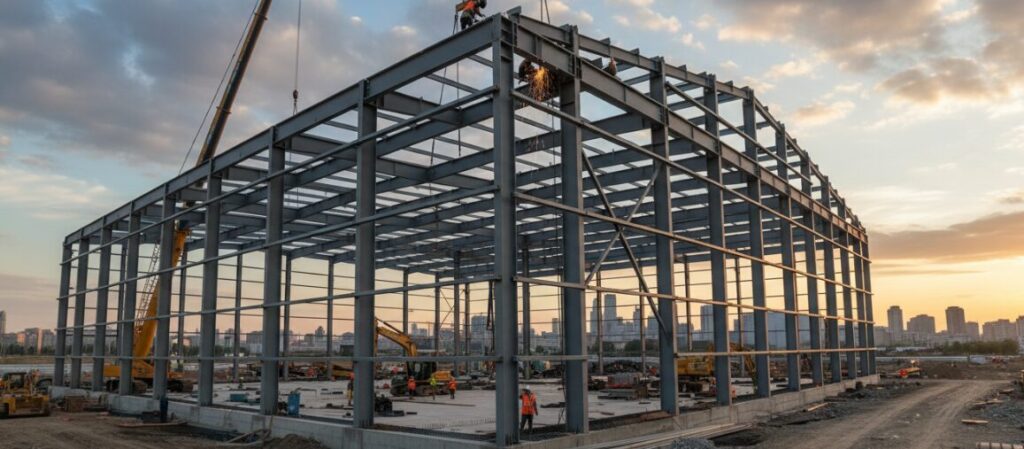
The whole construction logic is as follows: the main frame (rigid frame columns and inclined beams) is erected first, followed by the installation of secondary structures (wall beams and roof purlins), which provide lateral support for the wall panels and roof panels behind. After that, you must immediately put on structural supports (usually X-braces or portal frames) to save the house from swaying in high winds. When the skeleton is formed, the most critical step for novice or DIY players is to “level and alignment” with a theodolite or laser level before finally fastening the bolts “. Finally, all high-strength bolts must reach the specified torque-usually “initial tightening” and then add half a turn-to ensure that the house can withstand the wind and snow load. In this line of work, magnetic level, impact wrench, pointed crowbar these professional things are necessary.
This video provides a general overview of how to build a pre-fabricated steel frame:
Step 1: Foundation And Anchor Bolt Review
The steel structure frame is stable and unstable, and the ground reference is not allowed. Before the steel is put into place, the concrete base plate and anchor bolts must be strictly inspected.
- 1/16 Inch Principle: steel is not like wood, it is not so good toughness. If the anchor bolt position is offset by more than 1/16 inch, the column and the inclined beam will not be aligned, which will cause unnecessary internal stress in the entire structure.
- Leveling Treatment: sweep the laser level times. If there is a slight height difference in the bottom plate, it must be solved by leveling nuts or shim iron to ensure that the base plate is evenly stressed.
Step 2: Main Frame Hoisting
The main frame is the “backbone” of the building and consists of rigid frame columns (vertical supports) and inclined beams (sloping roof beams).
- Pillars In Place: use cranes or heavy forklifts to fit rigid frame columns into anchor bolts. Remember to put on heavy washers and nuts to lock first.
- Inclined Beam Assembly: I usually recommend bolting the inclined beam on the ground first, and then lifting the ridge assembly as a whole. This is much more efficient and safer than connecting one root at a high altitude.
- Node Connection: connect the inclined beam and column at the “armpit” (the intersection of the wall and the roof). At this time, the high-strength bolts are put in first, but don’t screw them completely in a hurry.
Step 3: Installation Of Secondary Structures (Wall Beams And Purlins)
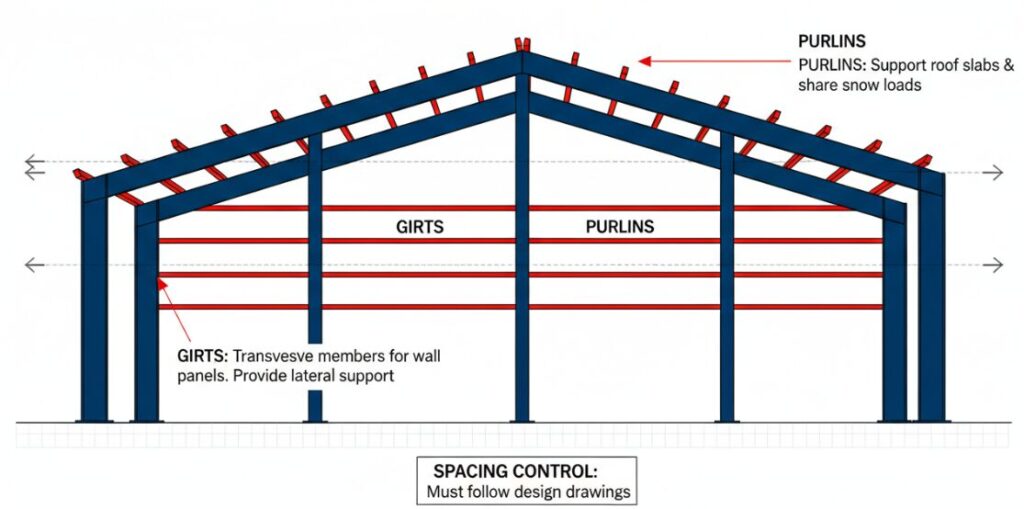
After the main frame is erected, it is necessary to quickly install the “row skeleton”, that is, the secondary component that provides the mounting surface for the outer panel.
- Girts: These transverse members are connected between columns. They not only provide lateral support, but also the stress point for hanging metal wall panels behind.
- Roof Purlin: across the inclined beam. Purlins are essential to support roof slabs and share snow loads.
- Spacing Control: the spacing between wall beams and purlins must be broken through the design drawings.
Step 4: Structural Support And Reinforcement
A steel structure without support is as easy to “twist” or shake as no bones.
- X-Type Support: usually steel strand or round steel, pulled into an “X” shape between columns or beams. They are responsible for guiding the wind loads back to the foundation.
- Portal Rigid Frame Support: if a certain compartment needs to be equipped with doors and windows and cannot pull the “x” diagonal brace, it must be replaced with a portal rigid frame to provide lateral rigidity without blocking the road.
Steel Structure Workshop
Steel Structure Workshops offer versatile designs. Clear Span ensures unobstructed space, while Centre and Intermediate Columns provide economical solutions for wide spans.
Bridge/Steel Structure Bridgeipsum
Steel Structure Bridges utilize high strength-to-weight ratios to achieve long spans where intermediate supports are difficult.Their versatility makes them essential for critical infrastructure connectivity.
Steel Structure Buildings
Steel Structure Buildings feature versatile designs to meet diverse needs. Clear Span offers open space, while Centre and Intermediate Columns increase economy for large spans. Multi Gable accommodates complex widths.
Step 5: The Skeleton Is Found And Plumb
Before tightening the bolts in the final large area, you have to make sure the house is “square” (all corners are 90 degrees) and “plumb” (the pillars are absolutely vertical).
- Instrument Detection: the professional dry method is to check the verticality of the column one by one with the theodolite.
- Adjustment Skills: use the tightness of the support cable to fine-tune the posture of the building. If the skeleton is crooked, the roof panel and edge-closing parts at the back will not be tightly pressed.
Step 6: Final Bolt Tightening And Torque
The final step is to completely lock the entire structure.
- “Initial Tightening” Method: first use an impact wrench to screw the nut to fit closely with the connecting plate.
- Half-Turn Principle: In order to meet structural engineering standards, most bolts need to be turned half a turn (180 degrees) on the basis of initial tightening. This tension is what keeps the house motionless in extreme snowy weather.
List Of Necessary Tools For Steel Structure Construction
If you want to be professional, you can’t make do with these tools:
- Pointed Crowbar: The tail is pointed and is specially used to align the bolt holes of heavy steel components.
- Magnetic Level Ruler: a suction to the steel column can work, free up two hands to adjust.
- Impact Wrench: hundreds of bolts, hand wringing will be tiring.
- Theodolite Or Laser Level: a needle that ensures that the entire house does not deviate.
Author: Marcus Thorne
“With over 17 years of hands-on experience in metal construction and structural engineering, I’ve overseen the erection of hundreds of steel structures. My expertise lies in precision framing and ensuring structural integrity through rigorous ‘squaring and plumbing’ techniques. I wrote this guide to share professional-grade insights that help DIYers and contractors alike build safer, more resilient steel buildings.”
