
 GAOERJI STEEL


Search
How To Wire A Steel Building
There are only most effective solutions: use mechanical clamps and magnetic bases to fix electrical boxes, and never drill those structural steel beams.
In terms of wiring, which is what we often call Wiring Pathways, I usually recommend using metal-armored cables (MC Cable) or EMT conduits instead of standard Romex(NM-B). Only the metal sheath can really guard against sharp metal edges and those pervasive rodents.
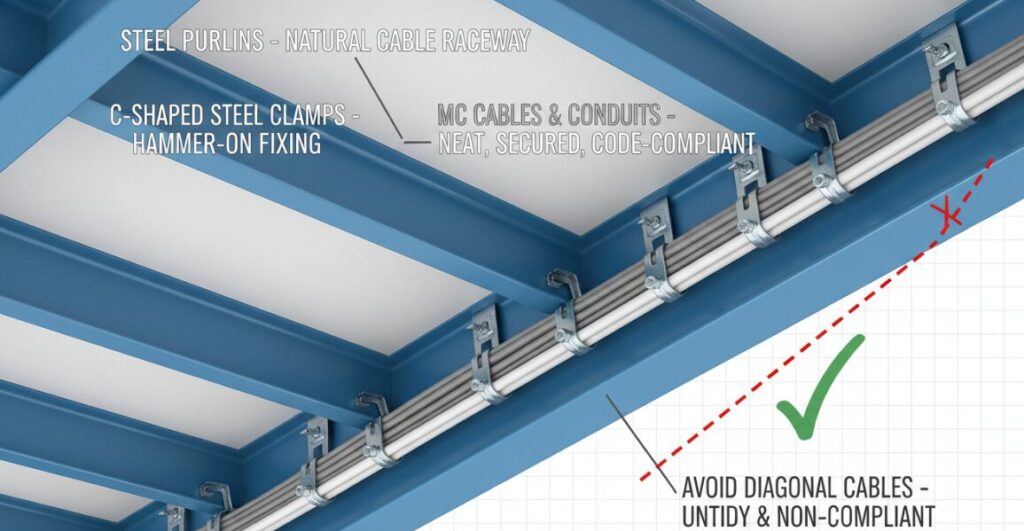
The core of the whole process is actually very clear: use beam clamps to fix the junction box on the red iron column or purlin; use C- shaped steel clamps to fix the cable along the purlin trend; finally, to ensure that the entire steel frame and grounding system reliable connection, to prevent the building itself live.
Jigs And Magnetic Attraction Schemes Are The Positive Solutions
When learning how to wire a steel structure, the first reaction of many people is to pick up an electric drill. Frankly speaking, this is often the mistake of newbies. Drilling holes in structural steel (also known as “red iron” in the jargon) will not only destroy the integrity of the beam, but in many cases, it will also directly cause the manufacturer’s structural warranty to fail.
In order to maintain structural integrity and secure equipment, mechanical fixture systems are currently the industry standard practice. These clamps can directly engage the flange of the I-beam or column, without removing any metal material, to provide an extremely strong anchor point for the electrical box.
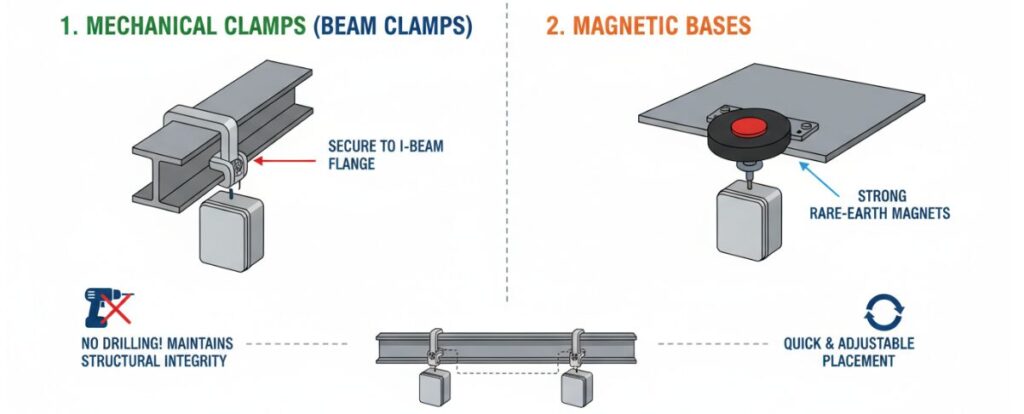
In addition to mechanical fixtures, high-strength magnetic bases have also become popular solutions in steel structures in recent years. The design load-bearing capacity of these rare earth magnets is quite amazing, which is very suitable for quickly arranging junction boxes on flat steel surfaces where the clamps cannot get in.
I usually use a mixture of beam clamps and magnetic bases. In this way, you have established a modular electrical system-if the process changes later and you want to adjust or move the position, you can do it at any time without leaving unsightly permanent holes in the structure.
MC Cable/EMT Conduit Vs. Romex
There is an essential difference between the wiring in the steel structure building and the traditional wood structure house, that is, the choice of cable type. Standard non-metallic sheathed cables (NM-B or commonly known as “Romex”) are usually not recommended in the surface installation of steel structures, and are even directly prohibited by many local codes.
Why I don’t recommend using Romex:
- Sharp edges: The steel structure is full of sharp metal edges (purlins, girth purlins and beam flanges). Romex’s soft vinyl sheath is too fragile in front of these hard stubble. A little rubbing or squeezing can easily cut it, directly causing a short circuit.
- Pest risk: Steel structures such as barns or workshops can easily provoke rats. Rats are very fond of chewing on NM-B cables, which is a huge fire hazard for electrical systems.
Solution: MC Cable and EMT Conduit
In accordance with best practice, metal armored cable (MC Cable) is the first choice for most lines. Its interlocking metal armor not only provides the flexibility required for wiring, but also resists cutting, abrasion and mouse teeth.
If you need extreme physical protection in this area, or seek that neat industrial-style aesthetic, EMT (metal electrical conduit) is another option. Although the elbow and installation is indeed more labor-expensive, it can provide a solid steel barrier for your wires. Whether it is MC or EMT, you can ensure that your wiring can withstand the harsh environment in the workshop or garage.
Using Purlins And C-Shaped Steel Clips
Steel Structure Workshop
Steel Structure Workshops offer versatile designs. Clear Span ensures unobstructed space, while Centre and Intermediate Columns provide economical solutions for wide spans.
Bridge/Steel Structure Bridgeipsum
Steel Structure Bridges utilize high strength-to-weight ratios to achieve long spans where intermediate supports are difficult.Their versatility makes them essential for critical infrastructure connectivity.
Steel Structure Buildings
Steel Structure Buildings feature versatile designs to meet diverse needs. Clear Span offers open space, while Centre and Intermediate Columns increase economy for large spans. Multi Gable accommodates complex widths.
In an open-frame steel structure building, cable management is essential. You can’t simply pull the cables around between the spans; they must be supported at regular intervals.
The structural “C-beams” or purlins on the roof and walls are in fact natural perfect trunking (Raceway). In order to fix MC cables or conduits on these paths, we will use special C- shaped steel clamps (or flange clamps). These clips only need to be struck with a hammer to snap to the purlin edge, providing a snap-in or threaded fixing point for the cable.
This method keeps the cable neatly high, away from potential mechanical damage, and looks very professional. Following the purlin avoids the messy diagonal diagonal cables-the diagonal cables are not only ugly, but also usually violate the requirements of the code on the support distance.
Equipotential Bonding Of Steel Frames
When wiring a steel structure, the most important safety step is to connect.
Because the entire building is made of conductive metal, in theory, as long as a loose fire wire touches any part of the frame, the entire structure (walls, roof, beams) may be electrified.
In order to prevent this potential electric shock, you must ensure that the steel frame is electrically connected to the grounding system. This means that you need to pull ground conductor from the main switchboard and connect it directly to the steel structure.
In the event of a fault, the fire contacts the steel structure, and this connection ensures that the current has a low impedance path back to the switchboard, allowing the circuit breaker to trip immediately. Never take it for granted that a building is bolted to concrete, even if it is “grounded”-according to the specification, the installation of a dedicated junction jumper is an absolutely non-negotiable and rigid requirement.
Author:Mark Stevens
“I’m a master electrician specializing in industrial and agricultural steel structures. With over two decades of field experience, I focus on code-compliant installations that preserve structural integrity. In this guide, I share my proven methods for using beam clamps and MC cable to wire your workshop or barndominium safely, ensuring your system is grounded and built to last.”
