
 GAOERJI STEEL


Search
Can You Use PVC Conduit In A Steel Building
Yes, you can use PVC conduit in a steel building, but it is most effective for underground runs or areas exposed to corrosive chemicals. For exposed indoor applications, metal conduit (like EMT) is generally preferred due to superior physical protection against impact and better fire safety, as PVC can melt and release toxic fumes. Before installing, always check local electrical codes and occupancy classifications, as PVC use is often restricted in buildings with large assembly areas (100+ people). Finally, unlike metal conduit which acts as a ground, PVC is non-conductive, so you must install a separate grounding wire.
Best Application Scenario
Although the metal trunking in the steel structure is the mainstream, in some specific scenarios, PVC (polyvinyl chloride) line pipe does have an irreplaceable advantage.
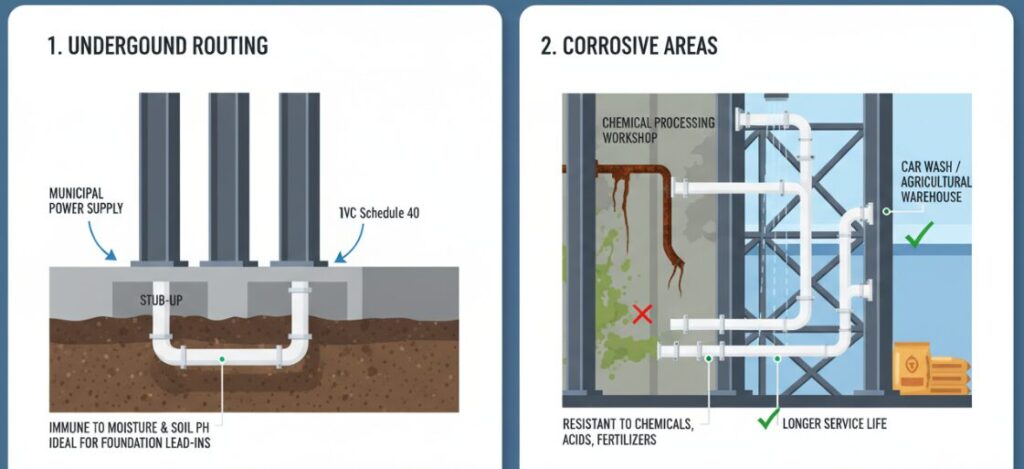
Underground Routing:
This should be the most efficient use of PVC in a steel structure project-buried directly under the concrete floor. Usually before the steel structure is erected, we will use the Schedule 40 or 80 standard PVC pipe to introduce the municipal power supply. It is completely immune to moisture and soil pH, and it is the perfect choice to make the “upper lead (stub-ups)” through the foundation.
Corrosive Areas:
Many steel structures are used for agricultural warehouses, chemical processing workshops or car washes. In this kind of environment, I have seen too many metal pipes (even galvanized) quickly rust and rot. At this time, PVC shows its ability. It is naturally resistant to chemicals, acids and fertilizers. In these harsh environments, it is a safer and longer life choice.
Why Do I First Push The Metal Tube (EMT)
Although PVC has its good, but in the case of indoor open (exposed indoor runs), EMT (thin-walled metal wire tube) is almost rolled existence. This comes down to two life-and-death factors: physical durability and fire performance.
Physical Protection:
Steel buildings are usually used as workshops, warehouses or garages, where heavy machinery and forklifts run back and forth. The exposed PVC pipe is much more brittle than the steel pipe. If the forklift touches it slightly or the heavy tool hits it, the PVC may be broken directly, and the live wires inside will be exposed instantly. In contrast, EMT provides a strong physical barrier, hitting hard at most a flat piece, not breaking, and preserving the integrity of the electrical system.
Fire Safety And Toxic Fumes:
In a closed steel structure, the biggest hidden danger of PVC is its reaction to heat. In the event of a fire, the PVC line pipe melts and burns, releasing chlorine gas and other toxic fumes. To be honest, the smoke is often more deadly to trapped people than the fire itself. The metal conduit is a non-combustible material, which can even “smother” the internal electrical fire in the pipe to prevent the fire from spreading to the insulation layer or structure of the building.
Steel Structure Workshop
Steel Structure Workshops offer versatile designs. Clear Span ensures unobstructed space, while Centre and Intermediate Columns provide economical solutions for wide spans.
Bridge/Steel Structure Bridgeipsum
Steel Structure Bridges utilize high strength-to-weight ratios to achieve long spans where intermediate supports are difficult.Their versatility makes them essential for critical infrastructure connectivity.
Steel Structure Buildings
Steel Structure Buildings feature versatile designs to meet diverse needs. Clear Span offers open space, while Centre and Intermediate Columns increase economy for large spans. Multi Gable accommodates complex widths.
Fix Regulatory Compliance And Personnel Density Limits
Local codes and classification of building use (Occupancy Classifications) play a decisive role.
Many building codes (including the NEC) have a key threshold for “Places of Assembly. If your steel structure-or a specific area within it-is designed to accommodate 100 people or more (such as a church, community hall, or large restaurant), non-metallic trunking (like PVC) is usually strictly prohibited or highly restricted. This rule exists to minimize the risk of smoke and toxic gas inhalation during an emergency evacuation. Therefore, before you think about saving money with PVC in a crowded place, be sure to look through the local specific electrical code chapters.
Differences In Grounding Systems
The last difference that must be made clear is the grounding system. If you decide to use PVC in a steel structure, you must consider its “non-conductive” characteristic.
Metal Conduits:
In many installation cases, the metal tube itself (whether EMT or hard tube) can legally act as the equipment grounding conductor (of course, depending on the specific specifications), which makes the wiring process much simpler.
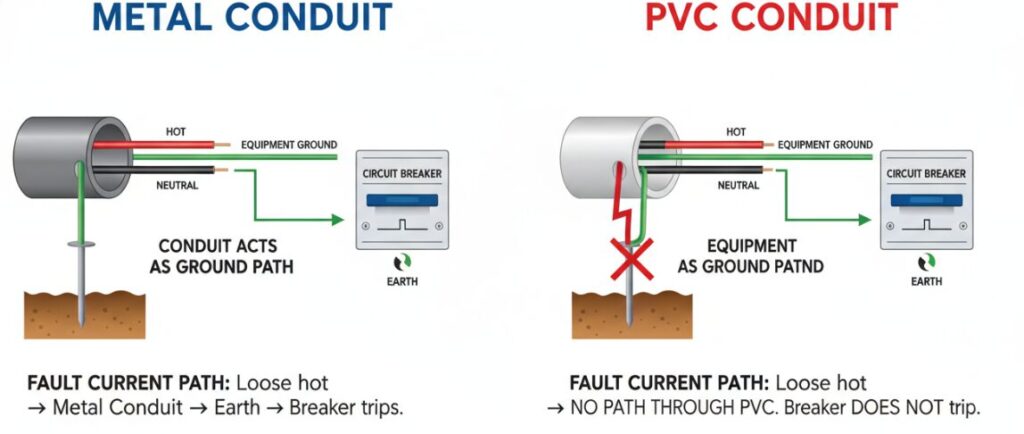
PVC Conduit:
Plastic is non-conductive. This means that if one of the fire wires is loose and is placed on the PVC pipe wall, the pipe cannot lead the fault current to the earth to trip the circuit breaker.
Hard Requirements:
When using PVC, you must 1 a separate, insulated ground wire (usually green) in the pipe and go with the zero wire of the live wire. This is to ensure that any electrical fault can be safely grounded. Although the PVC material itself is cheap, the material and labor costs of this extra copper wire should not be missed when you make the project budget.
Author: Mark Thompson
“Hi, I’m a master electrician with over 20 years of experience in commercial and industrial wiring. I specialize in electrical systems for steel buildings, helping owners navigate NEC codes and safety standards. I hope to provide clear, practical advice to ensure your electrical projects are safe, compliant, and built to last.”
